
 EN
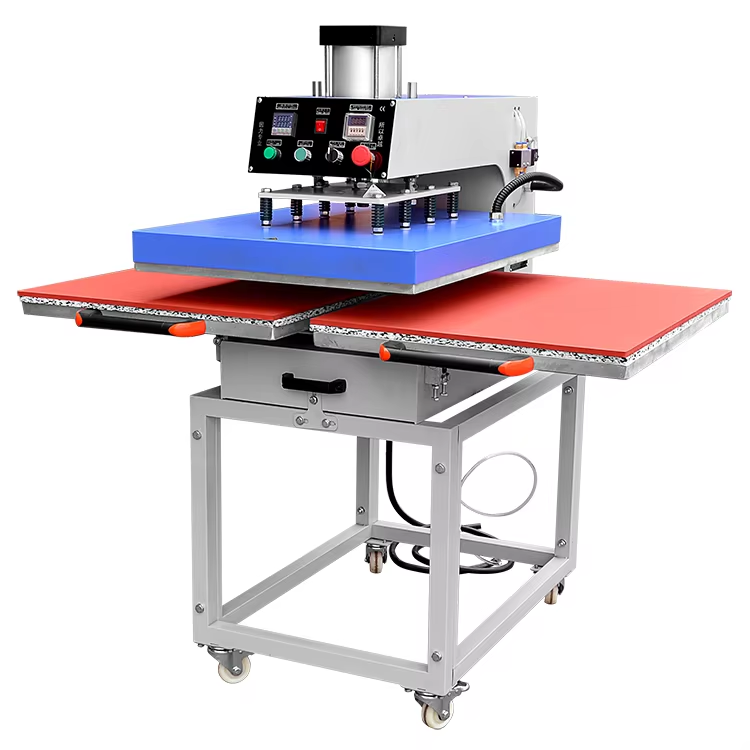
Why Pressure Balance Matters in a Double Station Heat Press Machine
Even slight pressure variations across stations or within a single platen can cause visible print defects—reducing production quality, increasing scrap rates, and triggering post-wash failures.
Consequences of imbalance: ghosting, edge lifting, and inconsistent DTF transfer adhesion
When pressure is too high, the DTF film compresses excessively, causing ink to spread and produce faint ghost images beside the intended design—eroding fine detail and registration. Low pressure prevents full melting of the DTF adhesive powder, resulting in poor fabric bonding; after cooling, edges lift and prints fail standard peel tests. Inconsistent station-to-station force is especially problematic in double station heat press machines: a 10 psi shortfall (e.g., 50 psi on the left vs. 40 psi on the right) directly causes patchy adhesion, faded spots, and speckled, dull areas where the powder fails to fuse uniformly. Because DTF relies on precise thermal and mechanical energy to activate the adhesive layer, uneven pressure compromises bond integrity at the microscopic level—defects often only emerging after laundering, leading to costly returns and rework. Routine verification with a calibrated pressure gauge between runs catches drift before it impacts output.
How platen misalignment and station-to-station variance degrade print uniformity
Platen misalignment is the most common root cause of uneven pressure distribution. If upper and lower platens are not perfectly parallel, contact force concentrates at the corners while the center receives insufficient pressure—creating gradient adhesion where prints appear solid at the edges but faded or incomplete in the middle. Mechanical wear on hinges, bent mounting plates, or frame distortion over time introduces subtle tilt, causing the platen to close unevenly. In dual-station configurations, independent mechanical assemblies can drift out of sync: one station may maintain a 0.2 mm gap while the other closes at 0.4 mm—a difference that translates to up to a 30% variance in effective clamping force. Critically, both stations often share a single control-panel pressure setting, masking this discrepancy until defects appear. Thermal paper analysis and shim testing reliably expose these inconsistencies, but without corrective action, uniformity degrades and scrap rates rise. Ensuring parallel, stable platens is foundational to consistent DTF transfer quality.
Step-by-Step Pressure Calibration for a Double Station Heat Press Machine
Manual calibration using pressure gauges, shim tests, and thermal paper analysis
Start by verifying air supply pressure: for pneumatic double station heat press machines, regulator output should consistently hold between 40–60 PSI—the optimal range for DTF transfers. If your machine lacks a built-in gauge, use an inline pressure tester on the air line for accuracy. Next, perform a cold shim test: with the machine open and cool, place feeler gauges or precision shims at all four corners of the lower platen. Slowly close the press and record the thickest shim that still allows full closure. A variation greater than 0.05 mm among corners confirms platen tilt. For dynamic validation, place thermal paper (or pressure-sensitive film) across the full platen surface, close the press at operating temperature for 3–5 seconds, then inspect the imprint. Uniform color intensity indicates even pressure; faint or absent areas reveal low-contact zones. Adjust platen leveling screws or the pneumatic regulator incrementally—and repeat the thermal paper test—until coverage is consistent across the entire surface.
Validating balance across both stations with standardized DTF test substrates
After individual station calibration, verify inter-station consistency using identical test conditions. Prepare two DTF test substrates: same fabric type, same transfer design, same pre-press moisture level, and identical machine settings. Press one in Station A and the other in Station B using your standard cycle. Immediately assess adhesion via peel testing and visual inspection for ghosting, edge lifting, or incomplete transfer. Any asymmetry signals residual pressure imbalance. If available, use a portable pressure gauge to measure actual force under load at both stations—differences exceeding 5 PSI correlate strongly with visible output variance. Recheck shim clearances on the underperforming station and adjust mounting hardware or regulator settings until both yield identical, clean transfers. Repeat this validation after maintenance, material changes, or seasonal humidity shifts to sustain repeatability across orders.
Troubleshooting Common Pressure Imbalance Causes in Dual-Station Operation
Pneumatic system leaks, uneven air supply, and regulator drift
Most station-to-station imbalances originate in the pneumatic system. Key failure points include:
- Air leaks at quick-connect fittings, solenoid seals, or hose couplings that bleed pressure preferentially to one station.
- Undersized or kinked air lines that restrict flow, especially when both stations actuate simultaneously.
- Regulator drift—where internal valve wear causes setpoint creep during operation, altering target pressure over time.
Begin diagnostics with a soapy-water leak test on all fittings and listen for hissing near solenoids. Confirm compressor output meets minimum requirements: at least 6 bar (87 psi) at the machine inlet under load, measured with a calibrated gauge. Replace any regulator showing measurable drift (>2 PSI deviation over a 5-minute cycle). Field data from a 2023 print shop survey found that tightening just three to four loose fittings resolved nearly 40% of reported dual-station pressure complaints.
Worn platens, bent hinges, or asymmetric mounting affecting station symmetry
Mechanical degradation can override even perfect air supply. Inspect for:
- Platen warping: use a straightedge and feeler gauge—gaps >0.1 mm across the surface indicate resurfacing or replacement is needed.
- Bent or loose hinge pins that allow rotational play, creating higher pressure at the leading edge of closure.
- Asymmetric base mounting due to uneven floor leveling, bent support frames, or shifted anchor bolts.
During routine maintenance, close each station onto a sheet of standard copy paper and measure corner gaps with feeler gauges. Variation across corners points to hinge or frame issues. Manufacturer service data shows that correcting workbench leveling alone resolved 25% of documented imbalance cases in 2024—underscoring how foundational mechanical stability is to pressure consistency.
Advanced Pressure Consistency Features in Modern Double Station Heat Press Machines
Modern double station heat press machines integrate automation to eliminate manual calibration guesswork. Self-balancing platen systems dynamically compensate for minor warpage or material thickness variation, maintaining uniform force across both stations. Digital pressure regulators—calibrated to ±1 PSI—replace analog dials, delivering repeatable, load-compensated force regardless of ambient conditions. Programmable controllers store substrate-specific temperature-pressure-time profiles, enabling one-touch recall for cotton, polyester, or blended fabrics. Real-time monitoring displays alert operators to deviations before they affect output, while automated alignment routines use embedded sensors to validate platen parallelism between cycles. Laser-assisted positioning further reduces setup error, ensuring consistent DTF adhesion without inter-cycle drift. These features transform pressure management from a reactive, skill-dependent task into a predictable, data-driven process—directly supporting ISO 9001-aligned production standards and reducing reliance on operator experience alone.
FAQ
Why is pressure balance crucial in a double station heat press machine?
Pressure balance ensures uniform force distribution across both stations, preventing print defects like ghosting, edge lifting, and inconsistent transfer adhesion.
How can platen misalignment impact DTF transfer quality?
Platen misalignment concentrates pressure unevenly, degrading adhesion and causing prints to appear solid at edges but faded in the center.
What's the recommended method for pressure calibration?
Use pressure gauges, shim tests, and thermal paper analysis to validate and adjust pressure distribution across all platens.
What causes station-to-station imbalances?
Pneumatic system leaks, air supply inconsistencies, regulator drift, and mechanical degradation are common culprits.
Do modern heat press machines solve pressure inconsistencies?
Yes, advanced models incorporate automation, self-balancing platen systems, and digital pressure regulators to ensure consistent and precise operations.
Table of Contents
- Why Pressure Balance Matters in a Double Station Heat Press Machine
- Step-by-Step Pressure Calibration for a Double Station Heat Press Machine
- Troubleshooting Common Pressure Imbalance Causes in Dual-Station Operation
- Advanced Pressure Consistency Features in Modern Double Station Heat Press Machines
- FAQ

