
 EN
EN
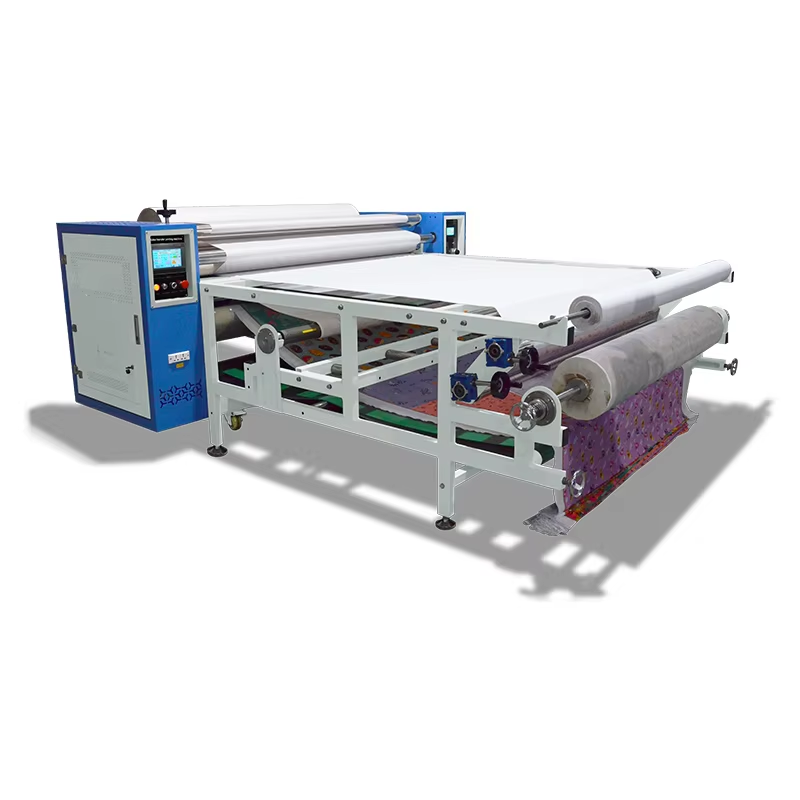
Roller Diameter and Transfer Width: Aligning Machine Scale with Production Requirements
How transfer width determines substrate versatility—from narrow trims to wide-format textiles
The transfer width of a roller heat press machine directly dictates the range of substrates you can process. A narrow width (12–16 inches) suits small-format applications like sleeve patches, pocket logos, and trim pieces—where precision on compact items matters most. In contrast, a wide-format machine (60+ inches) enables full-width textile processing for banners, flags, and roll-to-roll fabric runs. Matching transfer width to your typical job size avoids costly material waste and minimizes manual repositioning. For example, a print shop handling both 20-inch T-shirt designs and 54-inch soft signage panels needs a machine that accommodates the larger dimension without compromising alignment on narrower jobs. Selecting a width that exceeds your largest planned substrate by at least 2 inches ensures consistent edge-to-edge transfer and simplifies high-volume material handling.
Roller diameter’s role in fabric tension control, heat penetration depth, and wrinkle-free transfer
Roller diameter critically influences fabric tension control, heat penetration depth, and surface quality. A larger diameter increases the contact arc, distributing pull more evenly across stretchy or delicate textiles and reducing distortion. It also extends dwell time under pressure and temperature—allowing adhesives or sublimation inks to bond through thicker layers without surface scorching. For instance, a 6-inch-diameter roller maintains ±1°C thermal stability across heavy fleece, whereas a 3-inch roller may generate hotspots that cause wrinkles or incomplete adhesion. The smoother, more gradual pressure curve of a larger roller helps eliminate creases before the transfer point, delivering consistently wrinkle-free output—especially vital during continuous-duty production, where tension spikes from undersized rollers lead to misalignment and rework.
Heating System Performance and Temperature Stability for Reliable Transfers
The heating system of a roller heat press machine directly determines transfer consistency, energy efficiency, and substrate versatility. Selecting the right technology—and understanding how temperature precision impacts output—is essential for minimizing waste and sustaining quality.
Infrared, calrod, and ceramic heating technologies: comparing precision, uniformity, and response time in roller heat press machine operation
Infrared (IR) heaters use radiant energy for rapid warm-up and high energy efficiency, but their uniformity can vary with substrate color and reflectivity, requiring careful calibration. Calrod elements—metal-sheathed resistive coils—deliver highly stable, even heat distribution across the roller, making them ideal for long, uninterrupted runs. Though slower to respond than IR, they excel in thermal consistency. Ceramic heating offers a balanced alternative: faster warm-up and cooldown than calrod, with excellent uniformity and responsiveness. Dual-zone sensors paired with microprocessor-based PID controllers further refine all three systems, ensuring the entire transfer width remains within a tight thermal window—even as line speed fluctuates.
Why ±1°C stability matters: impact on ink adhesion, color fidelity, and reject rate reduction
Temperature deviations of just ±1°C can significantly compromise transfer integrity. Sublimation inks activate within a narrow thermal window; even slight under- or overheating prevents full gasification, causing patchy adhesion and faded or shifted colors—particularly in pastel palettes. A 2023 industry survey found that maintaining ±1°C stability reduced color-shifting rejects by 22%. In direct-to-film applications, excessive heat scorches adhesive powder, while insufficient heat leads to peeling. Precise thermal control ensures every inch of fabric receives optimal energy for polymer bonding—directly improving color fidelity, adhesion strength, and yield. As such, ±1°C stability is not an upgrade—it’s a foundational requirement for production-grade roller heat press machines.
Pressure Uniformity and Tension Management Across the Roll Path
Consistent pressure and precise tension across the full roller width are non-negotiable for defect-free transfers. Even minor pressure variations cause ghosting, color shifts, or incomplete ink adhesion—especially on wide-format graphics. High-performance machines achieve uniformity through crowned rollers, adjustable air cylinders, or segmented pressure zones that let operators fine-tune the nip profile across the width. Without this capability, production reject rates on critical jobs can rise by 5–12%, according to 2023 industry benchmarks.
Tension management is equally decisive. During continuous operation, substrates must feed smoothly—without stretching, skewing, or wrinkling. Fluctuations often stem from poor roll alignment, inconsistent unwind braking, or abrupt speed changes. Advanced systems integrate closed-loop tension control using load cells or dancer rollers that respond in real time to maintain web tension within ±2 N. This prevents telescoping on rewind spools and stabilizes the transfer gap from first meter to last. When evaluating a machine, confirm that its tension system supports automatic diameter compensation and that the roll path avoids sharp bends and friction points. A well-engineered web path reduces material waste and protects the roller’s silicone surface—extending service life and improving long-term ROI.
Automation Readiness and Throughput Optimization for Scalable Production
Smart integration features: encoder synchronization, PLC compatibility, and auto-start/stop for inline workflow efficiency
For scalable, high-volume decoration, the roller heat press must function as a responsive node—not a standalone tool—in an automated production line. Encoder-based synchronization aligns the roller’s rotation speed and position precisely with substrate feed rate, preventing stretching and misregistration during continuous transfer. Standard PLC protocol compatibility allows seamless integration into centralized control systems for real-time parameter adjustments, recipe recall, and predictive diagnostics—eliminating manual intervention. Auto-start/stop functionality, triggered by substrate presence sensors, cuts idle heating cycles and mechanical wear between batches, directly boosting throughput. Together, these smart features reduce operator dependency, shrink changeover time, and support linear output scaling as demand grows—transforming the press into a future-ready asset capable of adapting to varied product runs and line speeds with minimal reconfiguration.
Build Quality and Durability: Maximizing ROI in High-Use Environments
Critical durability factors—structural steel gauge, industrial-grade bearings, and thermal expansion mitigation in continuous-duty roller heat press machines
In high-volume production, build quality defines long-term ROI. Three durability factors are decisive: structural steel gauge, bearing grade, and thermal expansion management. A heavy-gauge steel frame—3 mm or thicker—provides rigidity to resist flex under sustained pressure, preventing roller misalignment and reducing structural-related maintenance costs by up to 40% (2023 Industry Report). Industrial-grade bearings, engineered for continuous-duty cycles, minimize friction and wear on rotating components—often doubling service intervals and slashing unplanned downtime versus standard alternatives. Thermal expansion is a silent threat: uneven roller expansion under heat causes pressure inconsistencies and premature transfer failure. Even a 0.5 mm deviation can trigger batch rejection. Leading designs mitigate this with precision-machined expansion joints and high-temperature alloys that preserve dimensional stability at sustained operating temperatures. Investing in these fundamentals ensures consistent quality, lowers total cost of ownership, and delivers reliable performance over years of heavy use.
FAQ
What determines the best transfer width for my roller heat press machine?
The transfer width depends on the size and type of substrates you work with. Choose a machine with a width larger than your largest planned substrate by at least 2 inches for optimal results.
How does roller diameter affect heat press performance?
Larger rollers improve tension control, heat penetration, and wrinkle prevention, especially for stretchy or thick textiles. They enhance thermal stability and ensure consistent transfer quality.
What temperature range is critical for sublimation inks?
Sublimation inks activate within a narrow thermal window, typically requiring ±1°C stability to ensure proper adhesion, color fidelity, and minimized reject rates.
Why is tension management important in continuous operation?
Proper tension management prevents substrate stretching, skewing, and wrinkling. Advanced systems with closed-loop tension control maintain stability, reducing waste and improving material handling efficiency.
What features make a roller heat press machine automation-ready?
Look for encoder synchronization, PLC compatibility, and auto-start/stop features, which facilitate integration into automated production lines and improve throughput scalability.
Table of Contents
- Roller Diameter and Transfer Width: Aligning Machine Scale with Production Requirements
- Heating System Performance and Temperature Stability for Reliable Transfers
- Pressure Uniformity and Tension Management Across the Roll Path
- Automation Readiness and Throughput Optimization for Scalable Production
- Build Quality and Durability: Maximizing ROI in High-Use Environments
- FAQ

