 EN
Scalability and Production Capacity of Large Format Heat Press Machines
Platen size advantages for oversized substrates and batch efficiency
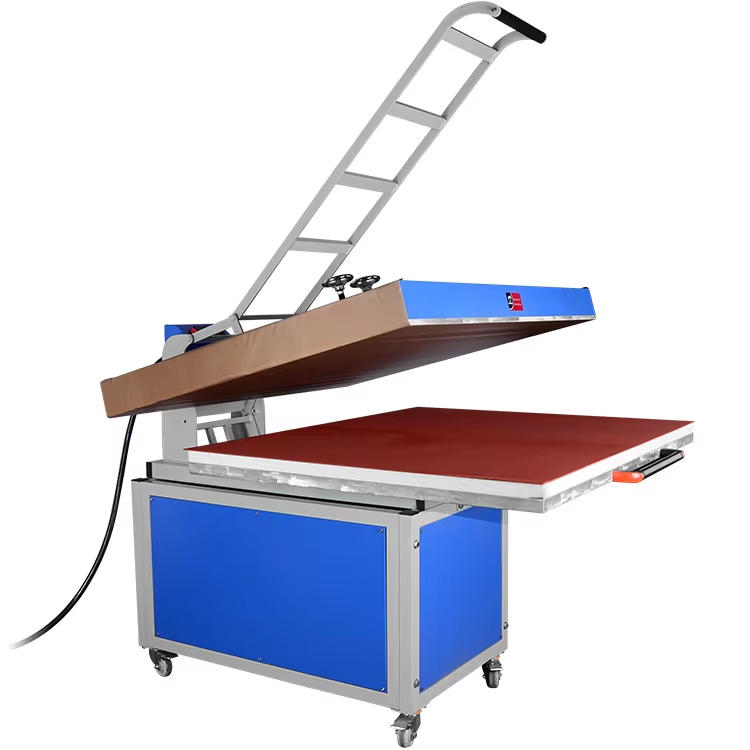
Large format heat press machines redefine batch production by replacing multiple small-format cycles with a single oversized platen. Equipment in this category typically starts at 16 × 20 inches (40 × 50 cm) and commonly reaches 60 × 80 inches (150 × 200 cm) or more—enabling full-front, full-back, and all-over transfers on sportswear, team uniforms, and technical textiles. A wider, deeper platen increases output per cycle by accommodating either multiple smaller items or one large panel, boosting throughput without adding labor. This is especially valuable for signage, industrial composites, and garments requiring uninterrupted surface coverage. Larger platens also eliminate alignment inconsistencies common when tiling graphics across separate presses. However, these benefits hinge on uniform heating and consistent pressure distribution; otherwise, oversized platens risk cold spots or uneven adhesion. For commercial operations, selecting an oversized platen is not about footprint alone—it’s about converting idle oven or manual table time into repeatable, high-volume throughput.
Single-cycle large-area transfers: reducing labor, cycle time, and bottlenecks
Single-cycle large-area transfers remove the multi-step handling that slows mid-volume and industrial production. Instead of pressing sleeves, front panels, or sign segments individually, operators load the full substrate, close the press once, and complete the transfer in a single dwell. This reduces direct labor per piece—fewer loading, alignment, and unloading actions—and cuts cumulative cycle time: one 60-second cycle on a 60 × 80-inch platen can replace three to four smaller press cycles. Compact machines with 40 × 60 cm platens often become bottlenecks because their platens lose heat between cycles and require recovery time. In contrast, oversized industrial units feature high-wattage heating systems and rapid thermal recovery, maintaining setpoint temperature across back-to-back jobs. By eliminating intermediate handling and reheating pauses, single-cycle operation supports leaner workflows and higher daily output—without increasing staff.
Durability, Precision, and ROI of Industrial Large Format Heat Press Machines
In commercial production, press performance is measured less by top speed than by consistent qualified output. Two factors decide profitability: thermal uniformity and mechanical repeatability.
Thermal uniformity and repeatability for consistent commercial-grade transfers
Industrial machines achieve transfer consistency through engineered platen construction and closed-loop temperature control—not just mass or thickness. Thick cast aluminum alloy or steel platens with distributed heating elements ensure even heat distribution across oversized substrates, minimizing cold edges and hot centers. Digital PID controllers hold temperature within tight tolerances (±2–3°F), while pneumatic or calibrated pressure systems maintain uniform face contact. This prevents scorching on delicate fabrics, under-curing on thick materials, and dye migration on polyester blends. Repeatability also depends on precise dwell timing and rapid pressure recovery between cycles—even minor fluctuations can compromise adhesive cure or colorfastness, increasing rework. According to a 2023 lifecycle review published by the Textile Machinery Institute, properly maintained industrial-grade platens routinely exceed 50,000 cycles before major service. For shops running multi-panel graphics, uniform heat across a 40 × 60 cm or larger platen enables reliable single-cycle pressing of multiple small items or one oversized panel—eliminating banding, ghosting, and edge inconsistencies. The result is repeatable commercial-grade output: identical wash durability, opacity, and adhesion from first to last piece. This precision directly lowers inspection time and customer rejects—key drivers of return on investment.
3-year breakeven analysis: TCO vs. output gains for mid-volume shops
A three-year total cost of ownership (TCO) analysis demonstrates clear financial justification for industrial large format models when qualified output rises. Consider a mid-volume shop processing 300 transfers per shift, five days per week.
| Factor | Light-duty press | Industrial large format |
|---|---|---|
| Rework rate | 8% | 2% |
| Rejected pieces/day at 300/shift | 24 | 6 |
| Labor + material cost per piece | $1.10 | $0.75 |
| Annual qualified output savings | — | $26,250 |
Reducing rework from 8% to 2% saves 18 pieces per day. At a $3.50 contribution margin per piece, that yields $15,750 in annual gross margin improvement. Combined with labor and material savings of $0.35 per piece across 75,000 annual pieces, total annual savings reach $26,250. Even with a $8,500 premium over a light-duty press, payback occurs in four to five months under typical conditions. Conservative scenarios—including lower volume or ramp-up time—still achieve breakeven within 12–18 months. Over three years, accumulated savings from higher throughput, fewer rejects, and extended service life typically exceed the initial purchase premium by two to three times—making precision and durability not just quality upgrades, but strategic growth enablers.
Advanced Automation Features Built for High-Volume Commercial Use
Dual-station operation, programmable presets, and pressure/temperature intelligence
Advanced automation in industrial large format heat press machines reduces manual intervention and stabilizes output in commercial environments. Dual-station operation separates loading and pressing zones, allowing operators to position oversized substrates on one platen while the other completes its transfer cycle. This overlap eliminates idle time between cycles and supports continuous, high-volume workflows.
Programmable presets let users store and recall exact time, temperature, and pressure profiles for different applications—apparel, rigid boards, or thick textiles—switching between recipes in seconds. This minimizes setup errors and empowers less experienced staff to deliver consistent results without constant supervision.
Pressure and temperature intelligence uses closed-loop sensors to monitor surface conditions across the entire platen. If temperature drifts beyond tolerance or pressure becomes uneven, the system automatically adjusts or alerts the operator—preventing defective transfers before they occur. These real-time diagnostics also support predictive maintenance, reducing unplanned downtime. Given the challenges of maintaining edge-to-edge uniformity on large surfaces, such intelligence is essential—not optional—for high-yield production. For mid- and high-volume shops, these features transform a single large-format press into a flexible, repeatable production cell capable of supporting just-in-time order fulfillment without added headcount.
FAQ
What are the advantages of using large format heat press machines?
Large format heat press machines improve production throughput by handling oversized substrates or multiple smaller items in a single cycle. They ensure precise, uniform transfers and reduce labor and cycle times, making them ideal for commercial-scale operations.
Why is thermal uniformity important in heat press machines?
Thermal uniformity ensures even heat distribution, preventing defects like scorching or incomplete transfers. This consistency directly impacts product quality and minimizes rejects or rework in commercial production.
What is the typical return on investment (ROI) for industrial large format heat press machines?
ROI can be achieved within 4–18 months, depending on production volume and improvements in throughput and reduction of rework. Over three years, savings often exceed the initial investment by two to three times.
How do advanced features improve high-volume heat press production?
Features like dual-station operation, programmable presets, and pressure/temperature intelligence streamline workflows, reduce errors, and support predictive maintenance, allowing for consistent, high-quality output without increasing labor costs.
Are large format machines suitable for small businesses?
Yes, depending on their production needs. Small businesses handling high-volume orders or requiring all-over transfers can benefit from the improved efficiency and reduced operational costs of a large format heat press machine.
Table of Contents
- Scalability and Production Capacity of Large Format Heat Press Machines
- Durability, Precision, and ROI of Industrial Large Format Heat Press Machines
- Advanced Automation Features Built for High-Volume Commercial Use
-
FAQ
- What are the advantages of using large format heat press machines?
- Why is thermal uniformity important in heat press machines?
- What is the typical return on investment (ROI) for industrial large format heat press machines?
- How do advanced features improve high-volume heat press production?
- Are large format machines suitable for small businesses?

