
 EN
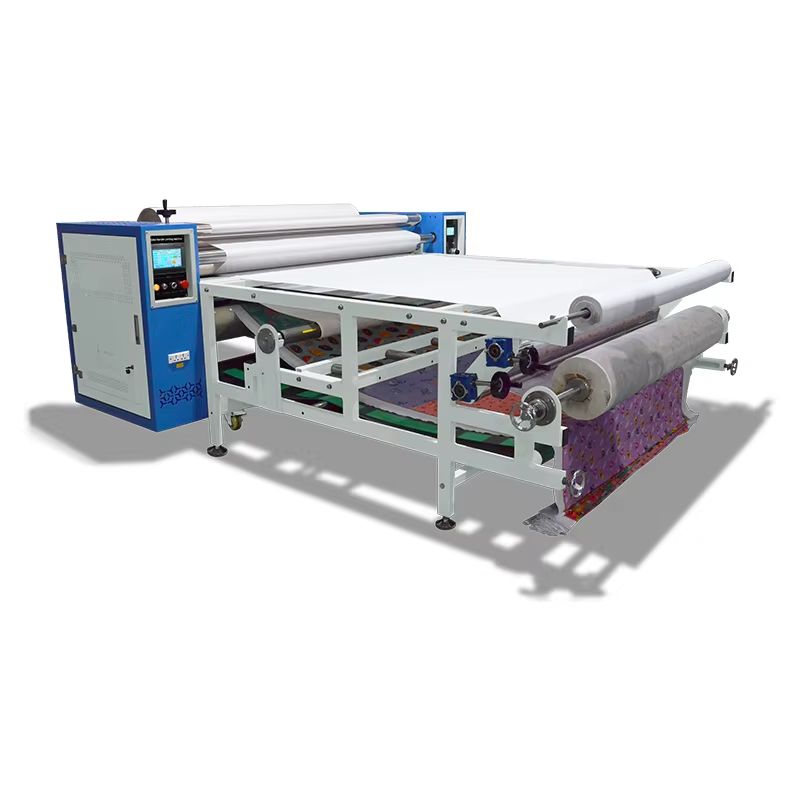
Core Capabilities and Key Specifications of Large Format Heat Press Machines
What Defines a Large Format Heat Press Machine?
Large format heat press machines are industrial-grade systems engineered for oversized substrates and high-volume production. Defined by platen sizes exceeding 16 × 20 inches (40 × 50 cm)—with top-tier models reaching 60 × 80 inches (150 × 200 cm) or more—they integrate precision heating elements, robust heat platens, and finely adjustable pressure systems. These machines transfer designs onto banners, flags, all-over-print garments, technical textiles, and rigid panels such as composites and automotive trim. Unlike desktop units designed for prototyping or short runs, large format presses support daily output of 250+ pieces—a benchmark validated across commercial print shops in 2025. Built with heavy-duty steel frames, dual-station or pneumatic operation, digital controls, and slide-out substrate trays, they prioritize thermal stability, structural integrity, and repeatable alignment over portability. Primary applications span textile decoration, signage fabrication, transportation interiors, and industrial composite bonding.
How Temperature Uniformity, Platen Size, and Pressure Control Impact Print Quality
Transfer fidelity at scale hinges on the precise interplay of three interdependent variables: temperature uniformity, platen size, and pressure control.
First, temperature uniformity ensures consistent curing across the entire surface. Variations beyond ±2°C across the platen cause banding, color shift, or adhesive failure—especially critical for wide-area transfers where edge-to-center gradients compound quickly. Industrial units mitigate this with multi-zone heating and factory-calibrated digital readouts.
Second, platen size directly affects pressure distribution. Larger platens require reinforced frames and mechanical leveling systems; without them, pressure drops significantly toward the edges—resulting in incomplete adhesion, misregistration, or curling at borders. Even minor misalignment compounds over repeated cycles, undermining registration accuracy.
Third, pressure control must be matched precisely to substrate thickness and compressibility. Insufficient pressure traps air and weakens bond strength; excessive pressure crushes delicate textiles or fractures rigid blanks like ceramic tiles and composite panels.
| Variable | Main Quality Risk | Operator Control |
|---|---|---|
| Temperature uniformity | Banding, color shift, adhesive failure | Digital readout, calibrated multi-zone heating |
| Platen size | Uneven edge pressure, alignment drift | Reinforced frame, manual or motorized platen leveling, validation via test prints |
| Pressure control | Incomplete transfer, substrate damage | Pneumatic or knob-adjusted settings calibrated per material thickness |
A critical validation step—performed after installation, major maintenance, or any platen realignment—is to run temperature-mapping film or pressure-indicating film across the full platen. This reveals cold spots, hot zones, or pressure voids before production begins. For large-format work, consistency across the full surface matters more than peak temperature or maximum pressure alone.
Step-by-Step Operation Protocol for Large Format Heat Press Machines
A repeatable setup sequence prevents most transfer defects. Complete both pre-press calibration and substrate-specific optimization before initiating full production.
Pre-Press Setup: Calibration, Platen Alignment, and Test Runs
Allow the machine to reach target temperature and stabilize for at least 10 minutes—never begin pressing on a cold or fluctuating platen. Verify the digital controller against an infrared thermometer at three points: left, center, and right. If readings vary by more than ±2°C, recalibrate the sensor or inspect the heating element for degradation.
Next, assess platen alignment. Place carbon paper or pressure-sensitive film between platens and close fully. Uneven impressions indicate misalignment—adjust leveling bolts incrementally until contact is uniform edge-to-edge. For pneumatic or hydraulic systems, confirm the pressure gauge reading corresponds to the manufacturer’s specified PSI at the platen surface, not just at the regulator. Clean both platens thoroughly with a lint-free cloth and non-abrasive cleaner; residual ink or adhesive compromises adhesion and risks contamination.
Finally, run a test transfer using the exact substrate and transfer material planned for production. Record actual surface temperature (not setpoint), dwell time, and pressure setting. If results show edge fading, scorching, or poor release, adjust pressure first—or add a heat press pillow for thicker or uneven substrates—before altering temperature or time.
Optimizing Temperature, Time, and Pressure Settings by Substrate Type
Substrate composition and transfer chemistry dictate optimal settings—not generic defaults. Use the table below as a verified starting point, then fine-tune through controlled test runs.
| Substrate / Transfer Type | Temperature Range | Dwell Time | Pressure Guidance |
|---|---|---|---|
| Cotton with HTV | 150–160°C | 10–15 sec | Medium-firm (35–45 PSI) |
| Polyester with sublimation | 190–205°C | 35–60 sec | Medium (25–35 PSI) |
| Cotton/poly blend with DTF | 130–150°C | 10–15 sec | Firm (40–50 PSI) |
| Light garment with transfer paper | 175–190°C | 15–20 sec | High (50–60 PSI) |
Always cross-reference these ranges with the transfer film or ink supplier’s technical data sheet. Remember: temperature, time, and pressure interact. A lower temperature can often be compensated with longer dwell—but extended time risks scorching synthetics. Excessive pressure may trigger dye migration or leave permanent platen marks. For thick or heat-sensitive substrates (e.g., foam-backed fabrics or coated rigid boards), reduce temperature slightly and increase dwell time rather than raising pressure. After each adjustment, press one test piece and evaluate adhesion integrity, color vibrancy, and carrier release before scaling up.
Diagnosing and Resolving Common Defects in Large-Scale Heat Transfers
Ghosting, Bleeding, and Incomplete Transfer: Root Causes and Fixes
Ghosting—a faint secondary image—typically arises from substrate movement during platen lift-off or aggressive peel force. Mitigate it by extending dwell time by 3–5 seconds to ensure full polymer flow and using low-tack application tape to hold the transfer in place during separation.
Bleeding, where ink spreads beyond design edges, signals overheating or overpressure. Reduce platen temperature by 5–10°F (3–6°C) and re-test on scrap material—avoid increasing pressure, which worsens lateral ink migration.
Incomplete transfer, marked by patchy adhesion or carrier film that won’t release cleanly, usually stems from insufficient pressure, uneven platen contact, or inadequate dwell time. Recalibrate pressure to the substrate manufacturer’s recommended range, revalidate platen leveling, and extend dwell time in 2-second increments until clean release occurs. Maintain a log of validated settings per substrate type—this accelerates troubleshooting and reduces repeat failures.
Essential Maintenance Routines to Maximize Uptime and Longevity of Large Format Heat Press Machines
Consistent, tiered maintenance preserves thermal accuracy, mechanical repeatability, and safety—especially vital for wide-platen systems where small deviations magnify across large surfaces. Most avoidable failures originate as minor oversights: ink buildup on the upper platen, unlubricated pivot joints, or unverified corner pressure drift.
Follow this evidence-based schedule—validated by field service data from leading manufacturers and commercial print facilities:
| Frequency | Key Action | Purpose |
|---|---|---|
| Daily | Wipe upper and lower platens with a clean, dry cloth while warm; verify temperature and pressure consistency across three points. | Prevent residue carryover and catch early calibration drift. |
| Weekly | Clean electrical compartments with compressed air; apply high-temperature lithium grease to pistons, rods, and pivot points. | Minimize dust-induced faults and mechanical resistance. |
| Monthly | Test pressure distribution at all four corners using standardized paper sheets; inspect heating elements, emergency stops, and platen flatness. | Confirm full-surface contact and operational safety. |
| Quarterly | Deep-clean platens with manufacturer-approved cleaner or >90% isopropyl alcohol; recalibrate temperature sensors and pressure transducers. | Restore baseline performance for wide-format consistency. |
| Annually | Schedule professional inspection of wiring insulation, pneumatic/hydraulic lines, and structural welds or frame integrity. | Detect latent wear before unplanned downtime occurs. |
Keep spare silicone pads and platen covers readily available—these simple spares prevent hours of production loss during component failure. Always power down and lock out the machine before cleaning electrical enclosures or applying lubricants, and wipe away excess grease to prevent transfer contamination. When followed rigorously, this protocol extends service life beyond 10 years while sustaining production-grade quality across thousands of large-format transfers.
Frequently Asked Questions (FAQs)
What is the typical size of a large format heat press machine?
Large-format heat press machines typically feature platen sizes starting at 16 × 20 inches and can exceed 60 × 80 inches in high-end models.
What industries benefit the most from large format heat presses?
Industries such as textile decoration, signage fabrication, transportation interiors, and industrial composite bonding frequently use large-format heat presses for their advanced capabilities.
How do I ensure temperature uniformity on my heat press platen?
Use multi-zone heating systems and recalibrate digital readouts regularly. Conduct temperature-mapping assessments to identify any inconsistencies.
What are the most common issues during heat transfer, and how can I fix them?
Common problems include ghosting, bleeding, and incomplete transfers. Address these by ensuring proper setup of temperature, dwell time, and pressure settings, along with platen alignment.
How often should I run maintenance on my large format heat press machine?
Follow a consistent maintenance protocol with daily, weekly, monthly, quarterly, and annual tasks to ensure operational reliability and longevity.
Table of Contents
- Core Capabilities and Key Specifications of Large Format Heat Press Machines
- Step-by-Step Operation Protocol for Large Format Heat Press Machines
- Diagnosing and Resolving Common Defects in Large-Scale Heat Transfers
- Essential Maintenance Routines to Maximize Uptime and Longevity of Large Format Heat Press Machines
-
Frequently Asked Questions (FAQs)
- What is the typical size of a large format heat press machine?
- What industries benefit the most from large format heat presses?
- How do I ensure temperature uniformity on my heat press platen?
- What are the most common issues during heat transfer, and how can I fix them?
- How often should I run maintenance on my large format heat press machine?

