 EN
How a Double Station Heat Press Machine Eliminates Production Downtime
The Core Mechanism: Parallel Loading, Pressing, and Unloading
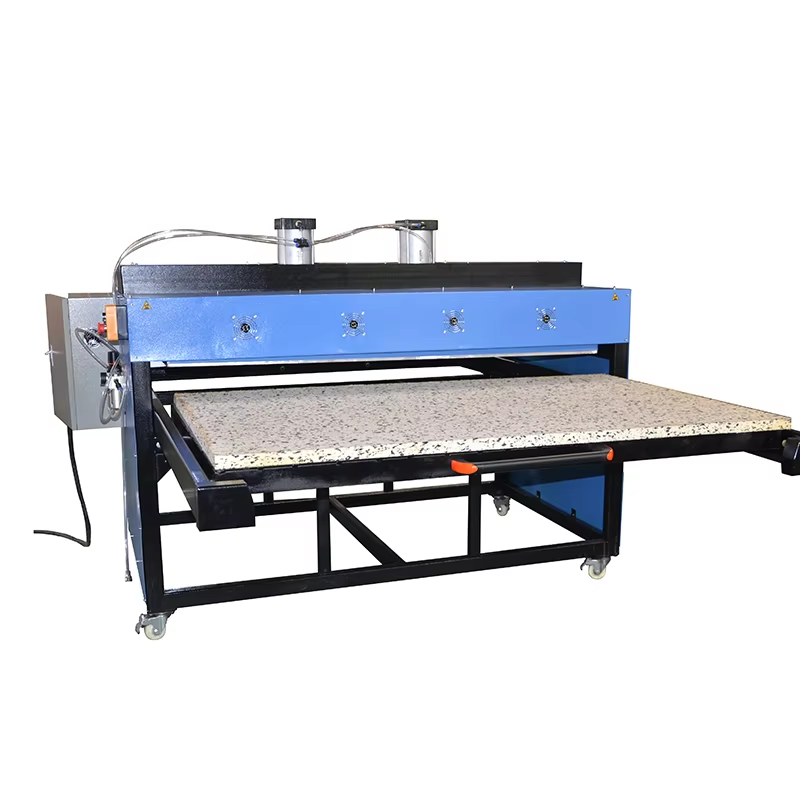
A double station heat press machine transforms stop-and-wait production into continuous flow. It features two lower platens and one movable upper heating head. While the head presses a garment on Station A, the operator unloads the finished item and loads a new blank on Station B. When the cycle ends, the head automatically shuttles to the waiting platen—enabling seamless handoff without idle time. Unlike single-station presses—where operators must wait through full dwell, peel, and cooling before loading the next piece—the double station design keeps the heating element active nearly continuously. Digital recipe storage, automatic shuttle controls, and safety interlocks ensure consistent pressure and temperature across both stations. This mechanical separation of material handling and pressing reduces operator fatigue, improves repeatability, and maximizes platen utilization. In high-volume DTF and apparel decoration lines, it eliminates microstops and lifts throughput close to double that of manual single-station units—limited only by loading speed, not press cycle duration.
Real-World Impact: Case Study — 42% Reduction in Cycle Time for an Apparel Decorator
One apparel decorator specializing in short-run custom orders replaced four manual single-station presses with two automatic double-station shuttle systems. Previously, each press required its own operator and suffered from full-cycle waits per garment. After the switch, two operators managed both dual-station units. Total cycle time per garment dropped 42%, from 58 seconds to 34 seconds (2023), while daily output rose to 1,400 shirts. Scrap fell sharply due to digital temperature control holding uniformity within ±2°C. The electric shuttle design also eliminated the need for a dedicated air compressor—reducing utility use and maintenance overhead. This case confirms that parallel loading doesn’t just improve press speed—it delivers faster order turnaround, lower labor cost per print, and greater resilience during peak demand without adding headcount.
Boosting Throughput and Labor Efficiency with a Double Station Heat Press Machine
Meeting On-Demand Demand: Scaling Low-MOQ Customization Without Bottlenecks
On-demand production—characterized by frequent small orders, varied artwork, and mixed garment types—exposes bottlenecks in single-platen workflows. A double station heat press machine decouples loading, pressing, and unloading so they occur simultaneously. While one platen cures a design, the operator preps the next garment on the second station. This continuity supports low-MOQ customization because changeovers overlap rather than stack: for example, aligning a left-chest logo on one side while positioning a full-front transfer on the other. As a result, decorators report up to 50% faster production times in high-volume settings—not by speeding up the press itself, but by eliminating setup competition with press time. That efficiency makes same-day or next-day fulfillment achievable without expanding floor space or adding equipment.
Optimizing Operator Workflow: One Technician Managing Two Stations Seamlessly
A dual-station layout enables one technician to manage both platens through a predictable, alternating rhythm: load Station A, start the press, then move to Station B to prep the next item. By the time Station B is ready, Station A’s cycle is complete—or nearly so. This minimizes idle standing and unnecessary walking. Strategic tool placement—keeping transfers, alignment aids, and cover sheets within arm’s reach—further sustains focus and flow. The result is higher output per operator hour, reduced training time, and lower physical fatigue. Shops maintain or scale production without hiring additional press operators. The natural cadence supports both long runs and rapid order changes—without disrupting pace or quality.
ROI Justification: Why Investing in a Double Station Heat Press Machine Pays Off Faster
A double station heat press machine redefines ROI by converting idle loading time into productive pressing time. In single-station workflows, operators frequently interrupt pressing to position garments, remove finished pieces, and prepare blanks. With two stations, one platen presses while the other is loaded—increasing qualified output per shift without added labor. ROI shouldn’t be measured by purchase price alone, but by value delivered over the machine’s service life: shipped products, labor efficiency, and yield stability.
Payback accelerates when calculated on qualified output, not theoretical speed. A fast press producing inconsistent results incurs hidden costs: inspection, rework, wasted film, and replacement blanks. Dual-station systems reduce manual handling and fatigue—lowering defect rates and material loss. For instance, if a single-station press yields 60 qualified pieces per hour and a dual-station unit produces 90 with the same operator, labor cost per piece drops by one-third—shortening payback and improving margin during peaks.
| ROI Factor | Single Station Workflow | Double Station Heat Press Machine Workflow |
|---|---|---|
| Platen utilization | Idle time during loading and unloading | Loading overlaps with active pressing |
| Labor cost per qualified piece | Higher because operator waits between cycles | Lower because one operator manages two stations |
| Rework and material waste | More handling steps, more chance of defects | Fewer manual transfers, more stable repeatability |
| Peak-season response | Requires overtime or additional shifts | Absorbs higher volume within standard hours |
| Expansion path | Add another operator and machine | Scale output without proportional labor increase |
Faster payback also comes from avoiding premature equipment upgrades. A business that outgrows a single-station press within six to twelve months incurs extra costs for installation, training, workflow redesign, and floor space. A double station heat press machine provides a scalable foundation—provided both platens deliver consistent temperature uniformity and repeatable clamping force. If one station runs cooler or applies uneven pressure, throughput gains vanish in rejected products. Over 12 months, higher qualified output, lower labor cost per piece, and reduced rework typically make the dual-station investment pay back faster than a lower-priced machine that becomes a bottleneck.
Selecting the Right Double Station Heat Press Machine for Your Production Volume
Key Specifications to Compare: Temperature Uniformity, Clamping Force, and Automation Readiness
Start with temperature uniformity: a cast aluminum platen paired with digital PID (proportional-integral-derivative) control and dual heater sensors maintains variation within ±2°C across both stations—critical for preventing scorched edges, cold spots, or under-cured transfers during long runs. Ensure the platen size accommodates your largest transfer sheet to maximize yield. Next, evaluate clamping force: choose adjustable pneumatic pressure—up to 450 kg (4,410 N)—for thick substrates like floor mats, or a 360 kg electric drive for standard apparel and DTF transfers. Lower force may fail on high-density materials. Finally, assess automation readiness: look for independent dual-platen control, semi-auto/manual modes, digital timers, and auto-release after curing—all essential for enabling one operator to load, press, and unload in parallel. Confirm safety compliance (CE certification), dual-hand start buttons, and emergency stop functionality. Digital readouts simplify routine calibration every 500 cycles. These three specifications directly determine cycle consistency, part quality, and uptime in continuous production.
Integration Tips: Pairing Your Double Station Heat Press Machine with Conveyor Dryers or CAD-Cut Workflows
To maximize throughput, integrate the press at the end of a CAD-cut workflow—so cut vinyl transfers move directly from plotter to platen without staging. Pre-cut masks and carrier sheets further reduce alignment time. For screen-printed or DTF transfers, position a conveyor dryer adjacent to the outfeed side: the operator can unload pressed garments onto the belt while the other station cycles. Use a modular, caster-mounted table to match press height with the dryer belt—minimizing repetitive reaching. Program the controller to stagger press times so one platen remains hot, ensuring fast temperature recovery and eliminating downstream bottlenecks. Avoid narrow aisles—maintain at least 1 m clearance around both stations for safe loading, maintenance access, and operator mobility.
FAQs
1. What is the key advantage of a double station heat press machine?
The main advantage is its ability to eliminate downtime by enabling parallel loading, pressing, and unloading. This enhances production efficiency and reduces operator fatigue.
2. How does a double station heat press improve ROI?
It boosts the qualified output per shift, lowers labor costs per unit, and reduces material waste—delivering faster ROI compared to single-station workflows.
3. Can one technician handle both stations of the heat press?
Yes, the alternating rhythm between the two stations allows one technician to efficiently manage both with minimal idle time.
4. What specifications should I look for in a double station machine?
Key specifications include temperature uniformity within ±2°C, adjustable clamping force, dual-station automation capabilities, and compliance with safety standards.
5. How do I integrate a double station heat press into my workflow?
Position it at the end of a CAD-cut workflow or near a conveyor dryer to optimize efficiency. Ensure appropriate spacing for safe operations and operator mobility.
Table of Contents
- How a Double Station Heat Press Machine Eliminates Production Downtime
- Boosting Throughput and Labor Efficiency with a Double Station Heat Press Machine
- ROI Justification: Why Investing in a Double Station Heat Press Machine Pays Off Faster
- Selecting the Right Double Station Heat Press Machine for Your Production Volume
- FAQs

