 EN
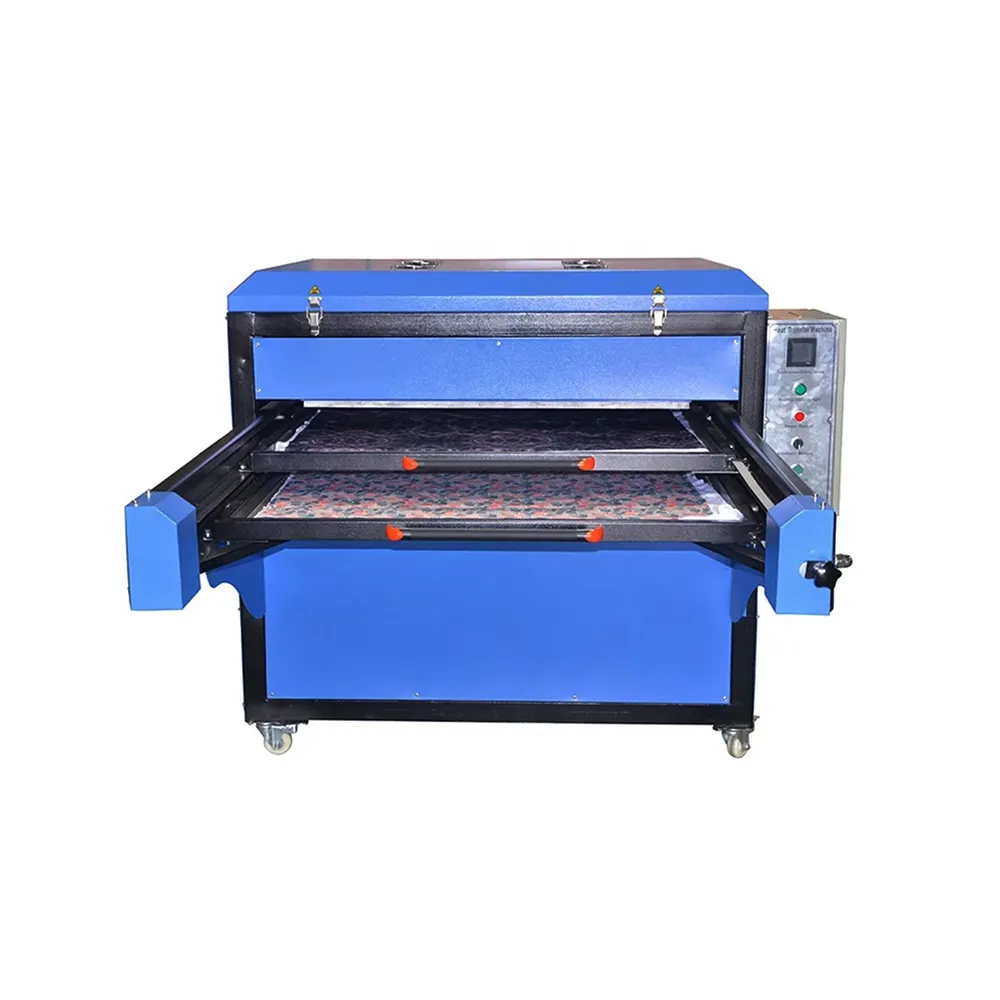
Higher Production Capacity for Bulk and Oversized Orders
A large heat press machine with a 20" × 25" or larger platen transforms high-volume decoration—replacing multiple single-item cycles with one full-platen load, press, and unload sequence.
Multi-substrate ganging on large platens (e.g., 20" × 25" and larger) boosts throughput
Large-format platens support simultaneous decoration of cotton, polyester, coated metal, rigid paperboard, and blended textiles in a single cycle. A 20" × 25" platen offers roughly 56% more usable area than a standard 16" × 20" unit, enabling operators to arrange six to eight tote panels, four to six youth jersey fronts, or up to twelve cap fronts side by side. This ganging strategy reduces per-unit setup, alignment, and weeding time. According to 2024 production studies, multi-substrate layouts on a 20" × 25" platen cut total press cycles for a 500-piece mixed-product order from ~165 cycles on a 16" × 20" press to 115—a 30% reduction. Because operators handle full platens rather than individual items, labor cost per decorated piece drops even when cycle duration remains unchanged. The result is higher daily throughput without added staff or floor space.
Measured cycle time reduction vs. standard 16" × 20" presses in high-volume garment fulfillment
In high-volume fulfillment, cycle time differences stem less from electrical heat-up and more from loading/unloading overhead. Standard 16" × 20" presses often require repositioning oversized artwork or multiple passes for full-front designs. In contrast, a 20" × 25" platen fits adult full-front graphics up to 14" × 18" in one placement—eliminating repositioning and restrikes. A 2024 benchmark of mid-size garment decorators found that a 20" × 25" press completed 100 adult full-front transfers in approximately 17 cycles versus 25 on a 16" × 20" press—a 32% reduction. At 45 seconds per cycle including manual handling, that saves about 6 minutes per 100 shirts. Across a 2,000-unit weekly run, the larger platen frees roughly 2 hours of operator time. These gains compound with multi-substrate ganging, making large-format equipment a practical path to scaling B2B fulfillment without proportionally increasing labor.
Superior Thermal and Pressure Uniformity Across Large Surfaces
IR thermography validation of heat distribution across 40″ × 64″ platens vs. industry ±3°C tolerance
Uneven heat and pressure cause ghosting, scorching, and weak adhesion—especially on oversized substrates. Large heat press machines with 40″ × 64″ platens address this through multi-zone heating and reinforced pressure distribution. Third-party IR thermography audits conducted in 2024 measured surface temperature at a 180°C setpoint across production platens: average edge-to-center deviation remained at or below 2.4°C. Standard 16″ × 20″ presses frequently approach or exceed the industry-accepted ±3°C tolerance. This tighter thermal profile minimizes cold spots near platen edges and improves adhesive cure consistency.
Pressure mapping shows parallel improvement. Across a 40″ × 64″ platen, contact force varied by less than 6%. Many smaller cantilever presses show 12–18% variation—particularly at corners—compromising edge-to-edge prints on rigid panels, all-over apparel, and large-format soft signage.
| Platen category | Edge-to-center heat deviation | Pressure variation | Common defect mode |
|---|---|---|---|
| Standard 16″ × 20″ | Often ±3.0–4.5°C | 12–18% | Edge scorch or cold peel |
| Large 40″ × 64″ | ≤±2.4°C | 4–6% | Minimal edge ghosting |
For B2B print operations, this uniformity reduces rejected panels, stabilizes repeat color, and simplifies quoting and production of full-bleed work.
Expanded Application Range for Non-Standard and Oversized Products
Full-front and full-back decoration of sports jerseys, oversized hoodies, and performance apparel
A large heat press machine removes the size ceiling imposed by standard 16" × 20" platens. Full-front graphics on sports jerseys often exceed 20 inches in width; full-back designs on oversized hoodies can reach 22–24 inches vertically. With platens of 20" × 25" or larger, operators complete these placements in one pressing cycle—avoiding awkward multi-pass transfers, tiling, and visible seam lines. Shoulder-to-shoulder graphics, tall jersey numbers, and oversized hoodie backs all fit cleanly. Performance apparel with moisture-wicking fabrics also benefits from uniform thermal control across the larger surface, protecting heat-sensitive fibers. As a result, shops can accept bulk orders for tournament jerseys, team outerwear, and promotional streetwear without outsourcing—enabling faster quoting, cleaner registration, and consistent batch-wide color. This expanded capability directly increases order eligibility and customer retention.
Diversified use cases: home décor panels, branded totes, and edge-to-edge custom mousepads
A large heat press machine unlocks non-apparel categories inaccessible to standard presses. Home décor panels—including 24" × 36" canvas prints, wooden wall art, and jumbo floor cushions—require broad, even pressure. A 40" × 64" platen handles them in one step, eliminating tiling. Branded totes with full-bleed graphics gain true edge-to-edge coverage without border voids. Custom mousepads in extended desktop sizes—often 31.5" × 11.8"—fit entirely under the platen for accurate, wrinkle-free adhesion. This versatility allows B2B print shops to diversify revenue beyond apparel: one production run can include fabric banners, placemats, and photo panels without changing core equipment. Switching among product types on the same large platen also reduces setup time and expands the catalog offered to corporate clients. In competitive markets, these non-standard formats often carry higher margins and stronger differentiation.
Future-Proof Scalability for Growing B2B Print Operations
A large heat press machine with modular platen design and automation-ready controls enables growing B2B print operations to scale capacity without replacing core equipment. Short-run and bulk oversized orders often arrive through the same sales pipeline, so a press that switches seamlessly between formats reduces setup friction and protects profit margins.
When evaluating scalability, decision-makers should prioritize three operational attributes:
- Ability to batch-process mixed oversized products on the same platen without frequent changeovers
- Automation-ready controls and remote diagnostics that reduce technician visits
- Compatibility with Web-to-Print (W2P) platforms—which can reduce job onboarding time by up to 70%
With the W2P market projected to exceed $30 billion by 2028, order velocity and customer expectations continue rising. A future-proof large-format heat press must therefore deliver not only greater print area but also faster, repeatable cycle times and consistent thermal uniformity as demand scales—ensuring upstream digital investments aren’t bottlenecked at the physical decoration stage.
FAQ
What are the advantages of using a large heat press machine?
Large heat press machines reduce cycle time, improve thermal uniformity, and enable decoration on oversized or non-standard products, providing versatility and scalability for B2B operations.
What types of products benefit from large-format platens?
Oversized sports jerseys, hoodies, home décor panels, branded totes, custom mousepads, and full-bleed canvas prints are ideal for large-format platens.
How does a 20" × 25" platen improve production efficiency?
It boosts throughput by accommodating more items simultaneously, reducing press cycles and labor costs while maintaining quality.
What is the importance of uniform thermal control?
Uniform thermal control ensures consistent adhesive curing, minimizes defects like ghosting, and improves edge-to-edge print quality.
Is a large heat press machine suitable for growing businesses?
Yes, these machines offer modular designs, automation-ready features, and compatibility with Web-to-Print platforms, making them ideal for scalability in growing B2B print operations.

