
 EN
EN
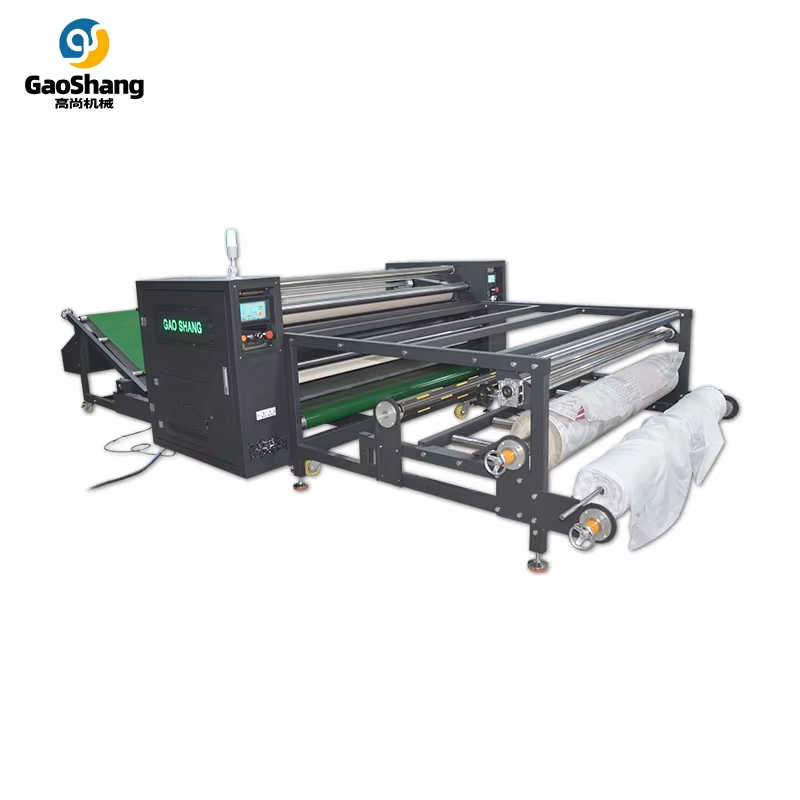
What Makes a Calandra Essential for High-Volume Commercial Sublimation?
Sublimation printing delivers vibrant, durable designs that never crack, peel, or fade. Yet scaling to high-volume production with standard flatbed heat presses creates critical bottlenecks—manual loading, cooling delays, and inconsistent edge-to-edge transfer limit throughput and quality. A calandra solves these challenges by transforming sublimation from a batch process into a continuous production line. Its roller-based system feeds rolls of polyester fabric or pre-treated blanks through precisely heated, pressure-regulated rollers in one seamless pass. This eliminates idle time between cycles and sustains production speeds of 10–20 meters per minute—up to five times faster than multi-station flatbed setups. With uniform temperature control across widths up to 1.8 meters, calandras ensure consistent, banding-free transfers without edge fade. For businesses producing thousands of garments, panels, or promotional items daily, the calandra is not just advantageous—it’s operationally indispensable for meeting tight deadlines, reducing labor dependency, and scaling profitably.
How Heavy-Duty Calandra Systems Boost Production Efficiency and Throughput
Heavy-duty calandras replace stop-and-go flatbed workflows with uninterrupted material flow—enabling dramatic gains in output, labor efficiency, and consistency. By eliminating manual handling between cycles, they convert labor-intensive batch processing into a lean, single-operator production line.
3–5× Higher Output vs. Batch Flatbed Systems: Continuous‑Feed Mechanics Explained
A calandra applies heat and pressure simultaneously across the full width of substrate and transfer paper as they pass continuously through precision-engineered rollers. Unlike flatbed presses requiring individual loading, pressing, cooling, and unloading, the calandra operates in a true end-to-end flow: operators load the roll at the inlet and collect finished, fully transferred material at the outlet. This design enables steady processing speeds of 10–15 meters per minute—three to five times faster than even optimized multi-station flatbed lines. No cycle resets mean no downtime, and no operator intervention between passes means predictable, repeatable throughput.
Case Evidence: U.S. Sportswear Manufacturer Achieved 220% Output Growth Post‑Calandra Integration
A mid-sized U.S. sportswear manufacturer producing custom team uniforms replaced a six-station flatbed setup with a single 1.8-meter heavy-duty calandra. Within three months, weekly panel output rose from 4,800 to over 15,000 pieces—a 220% increase. Labor costs dropped 40%, as one operator now managed the entire line versus three previously required for batch coordination. Defect rates fell below 1% due to uniform thermal application across the full width. The company recouped its calandra investment in just seven months—well ahead of the SGIA 2023 benchmark median of 8–14 months for similar commercial deployments.
Precision Heat Application: Why Calandra Delivers Superior Sublimation Quality
Consistent, controllable heat distribution is foundational to premium sublimation results—and calandras are engineered specifically to deliver industrial-grade thermal precision. Their continuous-pressure roller architecture ensures identical energy transfer across every square centimeter of substrate, eliminating the hot spots, thermal lag, and uneven dwell times common in batch systems. This level of control is essential for color fidelity, sharp detail retention, and long-term durability—particularly in performance-driven applications like sportswear, outdoor signage, and technical textiles.
Uniform Thermal Transfer Across 1.8m Widths—Eliminating Edge Fade and Banding
Edge artifacts and banding have long plagued wide-format sublimation, especially on panoramic or full-bleed prints where conventional ovens and flatbeds struggle with thermal scalability. Calandra systems resolve this using segmented, independently controlled heating zones guided by real-time feedback sensors—maintaining ±1°C tolerance across the full 1.8-meter working width. This dynamic thermal profiling eradicates banding (a leading cause of rejection in high-volume textile conversion, historically responsible for up to 27% waste in pre-calandra operations) and prevents edge fade caused by disproportionate heat loss at substrate margins. The result is consistently vibrant, edge-to-edge transfer—without compromise.
Evaluating Calandra ROI for Commercial Sublimation Businesses
Break-Even Timeline, Labor Savings, and Footprint Efficiency (Based on SGIA 2023 Benchmark Data)
A heavy-duty calandra delivers compelling financial returns for commercial sublimation businesses. According to the Specialty Graphic Imaging Association’s 2023 benchmark data, most adopters achieve payback within 8 to 14 months—accelerated further in high-utilization environments. Labor savings are the strongest lever: continuous-feed operation reduces direct operator involvement by up to 40% compared to batch flatbed systems, freeing staff for value-added tasks or enabling headcount optimization. Footprint efficiency compounds the benefit—a single calandra typically replaces three to four flatbed stations, reclaiming valuable floor space in crowded production facilities.
For example, a mid-size apparel decorator running 1,200 garments per day can reduce annual direct labor costs by approximately $35,000 while doubling throughput. Reduced reprints—driven by consistent heat and pressure—further improve net margins. When factoring in lower energy consumption per unit (due to optimized thermal efficiency) and reduced maintenance versus multiple flatbed units, the total cost of ownership is significantly lower than alternative high-volume heat press arrays. While exact modeling depends on local wage rates and volume profiles, SGIA’s 2023 data confirms that sub-18-month break-even is typical across commercial sublimation segments—from promotional product shops to contract textile converters.
FAQ Section
What is the main advantage of using a calandra for sublimation?
The primary benefit of using a calandra is its ability to transform sublimation printing from a batch process into continuous production. This results in significantly higher throughput, consistent quality, and reduced labor dependency compared to flatbed heat presses.
How does a calandra improve sublimation quality?
Calandra systems ensure uniform and controllable heat distribution across substrates, eliminating defects like edge fade, banding, and hot spots. This leads to superior transfer quality, vibrant colors, and sharper details.
What is the typical return on investment (ROI) timeline for a calandra?
According to SGIA 2023 data, most commercial sublimation operations achieve ROI within 8–14 months, depending on utilization rates and production volume.
How does a calandra compare to flatbed heat presses in terms of efficiency?
Calandra systems are 3–5 times more efficient than flatbed heat presses, thanks to their continuous-feed operation which eliminates downtime and manual handling between cycles.
Can a calandra reduce labor costs?
Yes, continuous-feed calandras typically reduce direct labor involvement by up to 40%, allowing for better allocation of workforce and lower operational costs.

