
 EN
EN
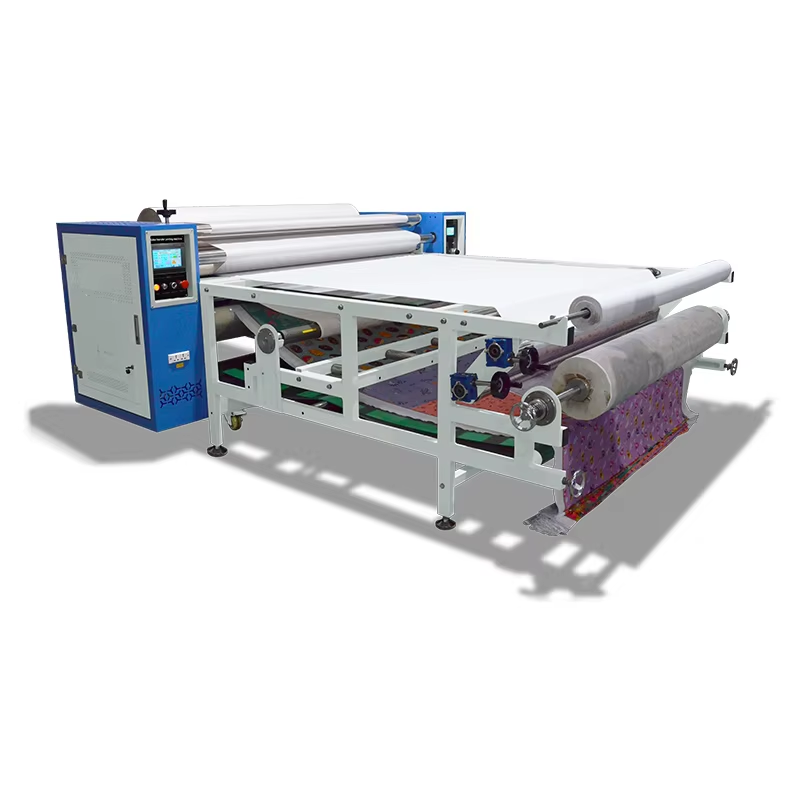
Why Calandra Performance Dictates Sublimation Quality and Throughput
The calandra’s ability to uniformly apply heat and pressure directly determines how effectively dye sublimation occurs—making it the linchpin of both print quality and production speed.
The non-negotiable role of heat fixation in industrial sublimation workflows
Heat fixation transforms solid sublimation ink into a gas that bonds permanently with polyester fibers. Without precise, consistent heat, dye fails to fully penetrate the fabric, resulting in faded colors, poor wash fastness, and material waste. In high-volume lines, even a 2 °C drop across the drum can shift the color gamut noticeably—triggering costly reprints. The calandra must sustain stable temperature across its full width and length throughout multi-hour shifts. This stability isn’t optional—it’s foundational for predictable, repeatable output. A machine unable to hold its thermal profile becomes a throughput bottleneck, forcing constant operator intervention or discarding defective rolls. Selecting a calandra with robust, closed-loop thermal control is therefore the first and most consequential decision in building a scalable sublimation workflow.
How calandra temperature uniformity, dwell time, and pressure control dye transfer efficiency and color gamut fidelity
Three interlinked parameters govern dye transfer: temperature uniformity, dwell time, and pressure. Drum surface variation exceeding ±1 °C creates uneven thermal energy delivery—causing inconsistent saturation and visible banding across wide-format prints. Dwell time—the duration the substrate contacts the heated drum—must be matched to fabric weight and ink load: too short, and dye remains on the transfer paper; too long, and colors bleed or substrates degrade. Pressure ensures intimate contact between paper and fabric; any air gap impedes thermal conductivity and blocks dye migration. Together, these variables define achievable color gamut fidelity. A well-calibrated calandra reproduces deep, vibrant hues consistently across entire production runs; a poorly tuned unit compresses the gamut and introduces off-shades. Operators must understand how each parameter interacts—and choose a calandra that enables precise, independent control of all three.
Matching Calandra Capacity and Configuration to Your Production Scale
Selecting the optimal calandra requires aligning machine capacity with your target production volume. For operations scaling from 500 m²/day to over 5,000 m²/day, three technical specifications are decisive: drum diameter, thermal mass, and line speed. Drum diameter determines heat contact area—larger drums (e.g., 600 mm vs. 300 mm) increase throughput without raising line speed. Thermal mass dictates how consistently the drum retains temperature during rapid, continuous runs; higher mass delivers stability for long shifts but extends warm-up time. Line speed must synchronize with sublimation paper feed rate to prevent ghosting or incomplete dye migration.
A logical progression is:
- Low volume (500–1,000 m²/day): Smaller drum (300–400 mm), moderate thermal mass, line speeds under 10 m/min to ensure adequate dwell time.
- Mid volume (1,000–3,000 m²/day): Mid-sized drum (400–500 mm), balanced thermal mass, variable speed up to 15 m/min for flexibility.
- High volume (3,000–5,000+ m²/day): Large drum (500–800 mm), high thermal mass for rapid heat recovery, speeds reaching 20–25 m/min.
Beyond capacity, application-specific tuning is essential. Soft signage benefits from lower pressure and higher speed to preserve drape and avoid fiber crushing. Decor applications—such as wall panels or roll-up banners—demand tighter temperature consistency across the drum to ensure uniform color over large areas, often requiring more granular dwell time control. Cut-and-sew apparel requires precise pressure calibration to prevent seam impressions while maintaining colorfastness. Programmable, profile-driven calandras eliminate manual recalibration—ensuring optimal dye transfer efficiency and minimal waste across diverse product lines.
Electric vs. Oil-Heated Calandra Systems: Thermal Precision, Stability, and Total Cost of Ownership
Comparative thermal consistency: ±1.2°C (electric) vs. ±3.8°C (oil) at 200°C across shifts
Thermal uniformity directly governs dye sublimation transfer quality. Electric heating systems maintain just ±1.2°C variance across the drum surface at 200°C—even during multi-shift operation. Oil-heated calandras, by contrast, drift ±3.8°C due to thermal lag in the oil circulation loop. That tighter electric control keeps the process within the narrow temperature window required for consistent dye uptake, reducing color shifts and material waste. For high-volume workflows where substrate temperature fluctuates, electric heating delivers repeatable results from the first meter to the last.
Scalability, maintenance, and energy cost implications for high-volume operations
Electric calandras scale efficiently via modular heating elements, simplifying integration into larger production lines. Maintenance is minimal—no fluid leaks, pump failures, or heat-transfer oil replacement. Oil systems require regular filter changes, seal inspections, and fluid replacement, increasing downtime and labor costs. Energy efficiency also favors electric models: they convert nearly 100% of input power into usable heat, whereas oil systems operate at 80–90% combustion efficiency. Over a five-year lifecycle, total cost of ownership for electric calandras is often lower—especially in regions with competitive electricity rates—due to reduced maintenance demands and consistent thermal performance.
Seamless Calandra Integration with Industrial Printers and Finishing Lines
A production-ready calandra must connect effortlessly to upstream printers and downstream finishing equipment. Without native integration, operators lose throughput managing manual media transfers and recalibrating settings for every substrate change. Modern calandras support industrial protocols—including EtherNet/IP, PROFINET, and OPC-UA—enabling real-time job data sharing between printer, calandra, and take-up system. This closed-loop communication automatically configures temperature, pressure, and speed based on material type, cutting setup time by up to 40% in high-volume facilities.
Connectivity alone isn’t enough—the calandra’s mechanical design must align with existing line layouts. Inline modules that accept printed rolls directly from the printer’s unwind station eliminate intermediate rewinding steps. Integrated cooling zones and slip-free winders allow direct feeding into cutters, slitters, or laminators—removing standalone handling stages. Leading manufacturers equip their machines with modular brackets and adjustable drum heights, enabling installation onto existing conveyor rails or floor-mounted tracks in hours.
Data management further strengthens integration. The calandra’s controller should log dwell time, temperature deviations, and throughput per job. When linked to a plant-wide MES (Manufacturing Execution System), these logs enable traceability and predictive maintenance. Synchronizing the printer’s RIP (Raster Image Processor) with the calandra’s PLC prevents mismatches between printed color density and fixation parameters—a leading cause of waste in sublimation workflows. Seamless integration transforms the calandra from a stand-alone heat press into a true production asset—one that scales reliably with output demands.
FAQs
Why is thermal uniformity critical in dye sublimation?
Thermal uniformity ensures consistent heat transfer during the sublimation process, minimizing color shifts and defects. It directly affects dye uptake and overall print quality.
What factors should I consider when selecting a calandra for my production scale?
Key considerations include drum diameter, thermal mass, and line speed. The choice depends on your target daily output and the specific application needs.
How do electric and oil-heated calandras differ in performance?
Electric calandras offer tighter thermal control (±1.2°C vs. ±3.8°C for oil), lower maintenance costs, and higher energy efficiency compared to oil-heated systems.
Can calandras integrate seamlessly into existing production lines?
Yes, modern calandras support industrial communication protocols and modular designs, allowing direct integration with upstream and downstream equipment for optimized workflows.
What are the advantages of programmable calandras?
Programmable calandras allow for application-specific settings and profile-driven adjustments, ensuring consistent dye transfer efficiency and reducing waste across product lines.
Table of Contents
- Why Calandra Performance Dictates Sublimation Quality and Throughput
- Matching Calandra Capacity and Configuration to Your Production Scale
- Electric vs. Oil-Heated Calandra Systems: Thermal Precision, Stability, and Total Cost of Ownership
- Seamless Calandra Integration with Industrial Printers and Finishing Lines
-
FAQs
- Why is thermal uniformity critical in dye sublimation?
- What factors should I consider when selecting a calandra for my production scale?
- How do electric and oil-heated calandras differ in performance?
- Can calandras integrate seamlessly into existing production lines?
- What are the advantages of programmable calandras?

