
 EN
EN
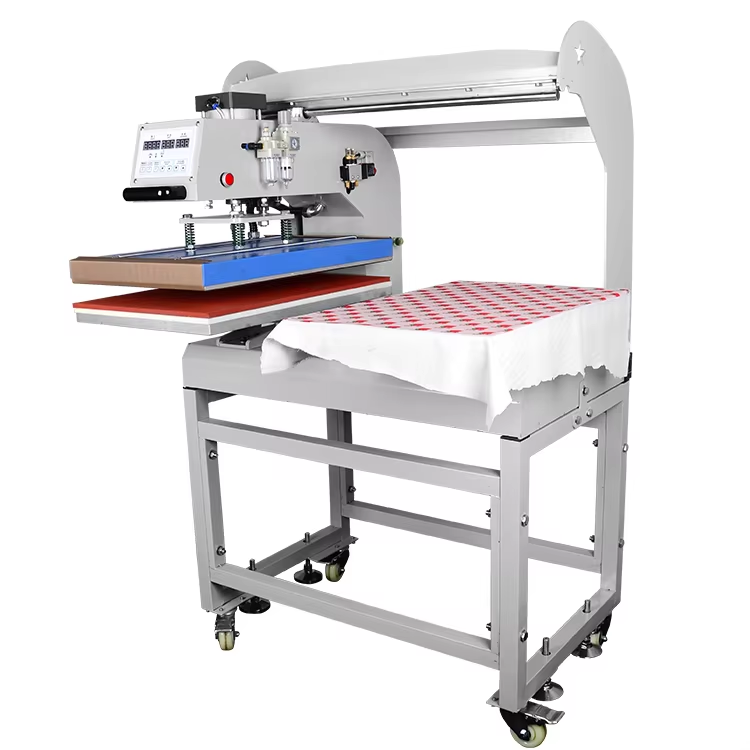
How Dual Heat Press Machine Architecture Enables Seamless Multi-Style Production
Independent dual-platen control: simultaneous yet distinct temperature, pressure, and time settings
The defining engineering advantage of a dual heat press machine is its independent platen logic—transforming one unit into two synchronized production lanes. Unlike single-station presses where loading and unloading idle the entire system, this architecture allows one platen to apply precise heat and pressure while the other is being prepared, reducing non-productive time to near zero. Each platen operates with closed-loop digital controllers, enabling vastly different settings in parallel: for example, 385°F with light pressure for 45 seconds on one platen (ideal for delicate polyester sublimation transfers), while the other runs at 320°F with high pressure for just 15 seconds (optimized for thick HTV on hoodies). This eliminates manual recalibration between jobs—a process that can take up to 5 minutes per changeover on conventional presses—and enables true concurrent manufacturing. A single operator can double effective hourly output by alternating seamlessly between pressing on platform A and prepping the next garment on platform B.
Precision alignment and infrared positioning for consistent registration across diverse print styles
Multi-style production demands micron-level repeatability—and advanced dual heat press systems deliver it through mechanical rigidity and intelligent positioning. High-rigidity guide rails and a fixed lower platen prevent lateral drift, eliminating ghosting or blurring on fine-detail DTF transfers. Integrated non-contact infrared grids project real-time alignment markers directly onto the work surface, simplifying placement of irregular items like tote bags or youth apparel and cutting misprint rates significantly. This capability is essential when rapidly switching between edge-to-edge A3 graphics and precise left-chest logos—each requiring unique registration points. Uniform, perpendicular pressure distribution ensures structural consistency even on complex substrates like zippered garments, preventing uneven bonding and adhesion failure common with standard presses.
Dual Heat Press Machine Versatility Across Materials and Garment Types
Adapting to challenging substrates: polyester blends, neoprene, coated canvas, and structured items (hoodies, bags, zippers)
Dual heat press machines excel where substrate variability would otherwise stall production. Polyester blends—prone to scorching or dye migration—can be processed at lower temperatures on one platen while cotton garments run at full heat on the other, all within the same cycle. Neoprene requires extended dwell times at moderate pressure to avoid delamination; such parameters are saved as repeatable digital profiles. Coated canvas for totes and outdoor gear benefits from interchangeable lower platens—flat or contoured—that ensure firm, even contact without cracking the surface layer.
Structured garments introduce additional challenges: hoodie seams and metal zippers distort heat transfer and block adhesion. Specialized accessories—like zipper-friendly platens or silicone elevation pads—lift the print area above obstructions, ensuring clean, impression-free transfers. Bags with straps or rigid panels leverage hinged or floating upper platens that self-level across uneven surfaces. By accommodating these materials and forms in one integrated system, operators eliminate tool-change downtime and cooldown pauses—reducing material waste and sustaining consistent quality across delicate tees, heavy-duty totes, and bulky hoodies.
Unified Workflow Support for DTF, Sublimation, and Heat Transfer Vinyl
Pre-programmed thermal profiles eliminate manual recalibration between printing processes
Switching between DTF, dye sublimation, and HTV typically disrupts workflow with manual recalibration—but dual heat press machines store and deploy multiple thermal profiles instantly. Operators select the appropriate preset from an intuitive controller menu, and both platens load exact temperature, pressure, and dwell parameters without adjustment. This prevents common errors like under-pressing sublimation transfers or overheating vinyl layers. For instance, shifting from full-color sublimation (400°F, 35 seconds, medium-high pressure) to a quick vinyl name drop (305°F, 10 seconds, light pressure) takes seconds—not minutes. According to industry benchmarks cited by the International Apparel Federation, this automation cuts cross-process changeover time by up to 70% compared to single-platen systems. The result is a unified, error-resistant production line capable of handling mixed-media orders with consistent yield and minimal rejects.
Productivity Gains: How Dual Heat Press Machine Efficiency Scales High-Volume Operations
A dual heat press machine redefines production rhythm by enabling continuous operation: while one platen presses, the other is loaded—turning batch processing into an assembly-line flow. This overlap eliminates idle gaps, converting traditionally stop-start cycles into seamless throughput. Real-world data from manufacturers using dual-platen systems shows a 50% increase in output—15 garments completed in seven minutes versus 10 on a single-station press. One operator manages both stations without compromising precision or consistency. During peak demand or large custom runs, this uninterrupted cadence prevents bottlenecks that routinely throttle single-platen operations. More than just speed, the system delivers scalable, repeatable results—maintaining identical pressure, temperature, and dwell across every item—thereby minimizing rework and maximizing daily yield.
FAQ
What is the key advantage of a dual heat press machine?
The primary advantage is its ability to operate two platens independently, allowing simultaneous production with distinct temperature, pressure, and time settings. This reduces downtime and improves productivity significantly.
How does a dual heat press machine handle structured garments?
Structured garments like hoodies and bags are accommodated using specialized accessories such as zipper-friendly platens or silicone elevation pads, which prevent distortion in heat transfer and ensure smooth, impression-free results.
Can dual heat press machines handle multiple printing processes?
Yes, dual heat press machines support various processes such as DTF, sublimation, and HTV. Pre-programmed thermal profiles eliminate the need for manual recalibration, enabling quick and seamless transitions.
What types of materials can a dual heat press machine work with?
It can handle polyester blends, neoprene, coated canvas, structured garments with seams or zippers, and more, ensuring high flexibility across diverse substrates.
How does a dual heat press machine improve productivity?
By enabling continuous operation through simultaneous pressing and loading, dual heat press machines increase throughput by up to 50% and maintain consistent quality in high-volume production scenarios.
Table of Contents
- How Dual Heat Press Machine Architecture Enables Seamless Multi-Style Production
- Dual Heat Press Machine Versatility Across Materials and Garment Types
- Unified Workflow Support for DTF, Sublimation, and Heat Transfer Vinyl
- Productivity Gains: How Dual Heat Press Machine Efficiency Scales High-Volume Operations
-
FAQ
- What is the key advantage of a dual heat press machine?
- How does a dual heat press machine handle structured garments?
- Can dual heat press machines handle multiple printing processes?
- What types of materials can a dual heat press machine work with?
- How does a dual heat press machine improve productivity?

