
 EN
EN
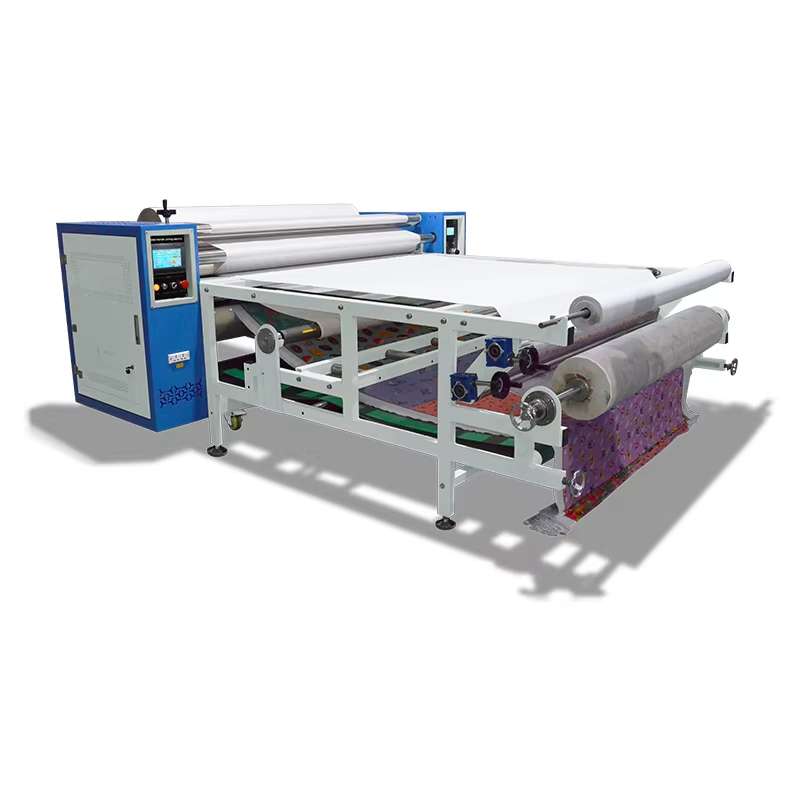
Roller Heat Press Machine Enables True Roll-to-Roll Production
Eliminating batch bottlenecks with continuous fabric feeding and heat transfer
A roller heat press machine redefines production flow by feeding fabric, transfer paper, and protective tissue from unwind stations directly into the heated drum—all without stopping. Traditional flatbed presses require operators to position individual panels, close the press, wait for dwell time, then cool and unload—a stop‑start rhythm that can waste up to 15% of a shift on material handling alone. In contrast, the roll‑to‑roll architecture merges the three webs before they wrap around the drum, maintaining a constant material stream. The fabric never pauses; as one section exits after sublimation, fresh material enters immediately. This continuous motion erases the idle gaps inherent in batch processing and keeps output linear. Print shops routinely report that switching from cut‑sheet flatbed operation to roll‑fed feeding eliminates the bottleneck of multiple changeovers, allowing one operator to oversee a machine that would otherwise require two or three workers on a flatbed line. The result is higher daily throughput, consistent dwell times for every millimeter of fabric, and far fewer chances for alignment errors or ghosting caused by repositioning.
Synchronized control of fabric speed, temperature, and pressure for seamless operation
Roll‑to‑roll success hinges on tight synchronization of web speed, drum temperature, and nip pressure. The drum’s speed determines dwell time—typically 25 to 45 seconds depending on fabric weight—while the heating system maintains setpoint within ±1 °C across the full working width (1.8 m to 3.2 m). A closed‑loop controller adjusts roller nip pressure to a tolerance of ±2 psi, compensating for variations in fabric thickness and preventing uneven transfer. When all three parameters are locked together, the fabric receives identical thermal energy along every linear meter, so sublimation dyes fully vaporize and migrate into polyester fibers without under‑transfer or scorching. Many machines use digital drives that automatically slow the drum if a temperature drop is detected—and accelerate gently once the heat bank recovers—preventing streaking or banding caused by variable drift. At high production speeds (2–6 m/min), the control system also manages web tension to keep fabric flat against the drum. The combined effect is uniform transfer conditions from the first to last meter—delivering predictable, repeatable color density across entire rolls without constant operator intervention.
Roller Heat Press Machine Ensures Precision Thermal and Pressure Consistency
Uniform heat distribution across wide-format rolls (1.8–3.2 m) for defect-free sublimation
Achieving uniform heat across the full 1.8–3.2 m width is foundational to defect‑free sublimation. The heating drum uses multiple independently controlled zones backed by oil or electric thermal systems, with multi‑point sensors confirming temperature variation stays within ±5 °C—even at speeds up to 6 m/min. The drum itself is machined from high‑grade alloy with optimized wall thickness for even conduction; deviations exceeding 2 °C across the span risk visible banding. A PID controller continuously adjusts heating elements using real‑time feedback, holding the temperature profile to less than 1% variance. This precision ensures sublimation inks fully gasify and penetrate polyester fibers uniformly—producing vibrant, wash‑fast prints without costly reprints. Fashion brands and soft-signage producers thus achieve consistent color fidelity from start to finish on demanding wide-format jobs.
Closed-loop pressure regulation (±2 psi tolerance) sustaining transfer integrity at high speeds
Reliable pressure control is equally critical at production speeds exceeding 8 m/min. Embedded load cells constantly measure nip pressure and feed data to a central controller that adjusts hydraulic or pneumatic actuators with ±2 psi tolerance. This closed‑loop system compensates for fabric thickness variations and mechanical roller deflection, maintaining uniform force edge-to-edge. With response times under 100 milliseconds, it eliminates transient dips during acceleration or splice passages. Operators pre‑set pressure profiles via touchscreen, and the machine holds setpoints without drift regardless of throughput. Such regulation prevents incomplete ink adhesion and ghosting—ensuring crisp, fully bonded transfers in a single pass. The result is reduced waste, preserved transfer integrity, and confident high-yield operation managed by one operator.
Roller Heat Press Machine Maximizes Scalable Throughput with Lower Labor Input
One operator managing multiple roller heat press machines versus labor-intensive flatbed workflows
Flatbed heat press workflows are inherently labor‑intensive, often requiring teams to load fabric, position transfers, press, and peel each piece individually—capping output per labor hour and escalating costs with volume. In contrast, a roller heat press machine with continuous roll‑to‑roll feeding and automated heat transfer enables a single operator to oversee multiple units simultaneously. This capability pushes throughput to hundreds of linear meters per hour while slashing direct labor requirements. Producers report over 50% reduction in labor costs—enabling scalable output without proportional staffing increases. The roller heat press machine delivers a demonstrably more cost‑effective, high‑volume solution than traditional flatbed methods.
Roller Heat Press Machine Supports Broad Fabric Compatibility for High-Yield Sublimation
Optimized performance on polyester and blends: >92% transfer yield vs. <40% on untreated cotton
Roller heat press machines excel at sublimation on polyester fabrics, achieving transfer yields exceeding 92% thanks to precise temperature control and uniform pressure. In contrast, untreated natural fibers like cotton yield less than 40% because they lack the polymer structure required for dye bonding. The machine’s consistent thermal and mechanical conditions across wide rolls prevent cold spots and distortion—even on thin polyester blends—making it ideal for high-volume production of sportswear, banners, and soft signage. By maintaining optimal heat and pressure, it ensures vibrant, durable prints on polyester and blends, while untreated cotton remains unsuitable for direct sublimation.
FAQ
What is a roller heat press machine?
A roller heat press machine is an automated system designed for continuous roll-to-roll production that sublimates designs onto fabric by maintaining constant temperature, pressure, and speed for high-quality results.
How is a roller heat press different from a flatbed press?
Unlike flatbed presses requiring manual handling and stop-start workflows, roller heat presses ensure continuous fabric feeding, faster production, and higher throughput due to their roll-to-roll architecture.
What fabrics are compatible with roller heat press machines?
Ideal fabrics for roller heat press machines include polyester and its blends, which achieve high transfer yields (>92%). Untreated cotton, on the other hand, yields much lower results (<40%) due to its natural fiber structure.
Can one operator manage multiple roller heat presses?
Yes, the automated design of roller heat presses allows a single operator to oversee multiple units simultaneously, significantly reducing labor requirements compared to flatbed workflows.
How does the machine maintain uniform quality during high-speed production?
Roller heat presses use synchronized control systems regulating web speed, temperature, and pressure, ensuring consistent thermal energy distribution and precise transfer conditions across wide-format rolls.
Table of Contents
- Roller Heat Press Machine Enables True Roll-to-Roll Production
- Roller Heat Press Machine Ensures Precision Thermal and Pressure Consistency
- Roller Heat Press Machine Maximizes Scalable Throughput with Lower Labor Input
- Roller Heat Press Machine Supports Broad Fabric Compatibility for High-Yield Sublimation
- FAQ

