
 EN
EN
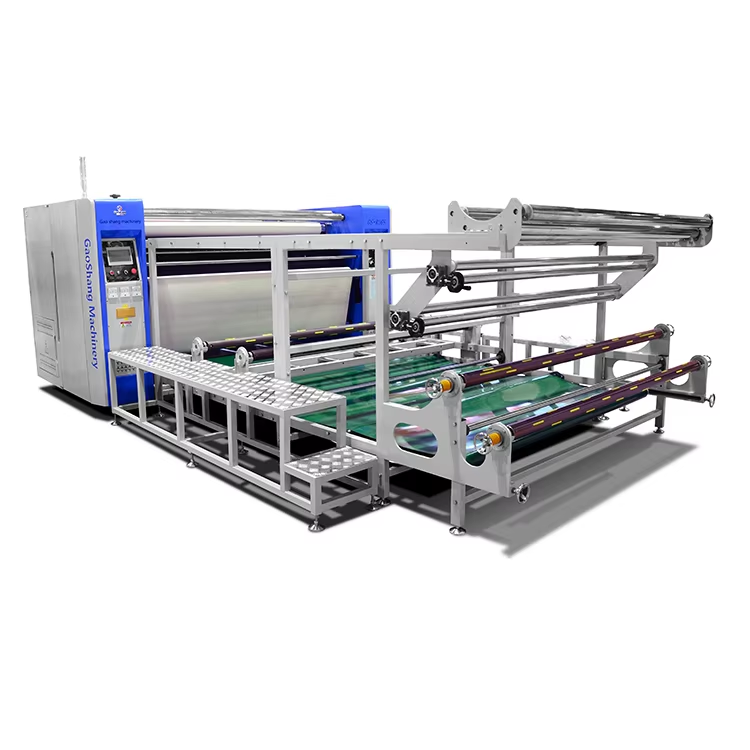
Roller Heat Press Machine Core Advantages for Home Textile Production
Transitioning from manual, piece-by-piece pressing to an automated process directly addresses the primary scalability challenges in home textile printing. The core engineering of these systems delivers two fundamental advantages: streamlining material logistics and stabilizing critical transfer variables to ensure uniformity across long production runs.
Continuous Roll-to-Roll Operation Eliminates Manual Handling Bottlenecks
A primary driver of production efficiency is the shift from a static, operator-dependent workflow to a dynamic roll-to-roll system. In conventional flatbed operations, the repetitive cycle of lifting, positioning, and removing individual fabric panels creates significant idle time between presses. This intermittent handling limits throughput—minor misalignments trigger rework, and operator fatigue degrades consistency over a shift. The continuous rotary drum mechanism eliminates these choke points by synchronizing the automated feed of fabric and transfer paper. Once a roll is mounted, the machine precisely draws both substrates across the heated roller in a single, uninterrupted motion. This reduction in manual touchpoints accelerates output—observed to increase by over 200% compared to flatbed loading in comparable facility configurations—and significantly reduces creasing or ghosting caused by fabric shifting during manual placement. An integrated automated take-up system allows a single operator to manage the entire print line, rebalancing labor allocation from repetitive loading to quality oversight and machine management.
Precision Temperature and Pressure Control Ensures Consistent Sublimation Transfer
The quality of a sublimated home textile—from vibrant curtain panels to detailed cushion covers—hinges on uniform heat and pressure application across every inch of fabric. Manual or semi-automatic presses often suffer from temperature drift and uneven pressure distribution, especially as heating elements cycle on and off, leading to visible color banding or incomplete dye transfer on larger panels. A rotary drum press overcomes these inconsistencies through a closed-loop thermal regulation system. Heat is distributed evenly across the entire circumference of the precision-ground drum, while a PID (Proportional-Integral-Derivative) controller makes real-time micro-adjustments to maintain target temperature within ±1°C. Crucially, pressure is applied not by a single platen but by controlled belt tension pressing the substrate against the drum—delivering linear, constant-pressure contact. This ensures sublimation ink gasifies and penetrates polyester fibers at a uniform rate edge to edge. The result is a ghost-free, production-grade finish where the first meter of a 100-meter bed linen run is colorimetrically indistinguishable from the last, eliminating waste from process variance.
Versatile Applications of the Roller Heat Press Machine Across Home Textiles
The versatility of the roller heat press machine extends far beyond apparel, offering transformative benefits for home textile manufacturers. From window treatments to bedding, its rotary technology enables both high-volume production and superior print fidelity on a variety of polyester-based fabrics.
High-Volume Production for Curtains, Bed Linens, and Upholstery Fabrics
When printing curtains, bed linens, or upholstery fabrics, the roller heat press transforms a traditionally labor-intensive process into a streamlined, continuous operation. Instead of laying individual panels onto a stationary platen, operators feed entire rolls of polyester or blended textiles directly through the heated drum and pressure rollers. This roll-to-roll workflow eliminates repeated manual alignment and transfer steps, enabling non-stop production of hundreds of meters per hour. Wide-format drums—commonly available up to 2.6 meters—accommodate standard home textile widths without splicing, preserving pattern integrity across large panels. Uniform heat distribution and consistent roller pressure ensure sublimation inks migrate evenly into fabric fibers, yielding vivid, durable graphics that resist fading after repeated washing. For bedding and drapery manufacturers, this efficiency translates directly into faster order fulfillment and higher margins—making the roller heat press indispensable for high-volume home textile production.
Ghost-Free Sublimation on Polyester-Blended Home Textiles
Polyester-blended textiles like blackout curtains or decorative cushion covers often challenge flatbed presses, which can create shadow images or “ghosting” when fabric shifts slightly during transfer. The roller heat press eliminates this defect through continuous, synchronized movement of the substrate and transfer paper under precise tension control. Because fabric and printed transfer paper advance at identical speeds through a narrow heating nip, there’s no opportunity for misalignment or double-printing. Advanced digital temperature controllers maintain drum surface temperature within ±1°C, while pneumatic pressure systems apply even force across the full roller length—critical for delicate blends that might scorch under uneven heat. This precision ensures intricate sublimation designs transfer cleanly without ghosting artifacts, even on lightweight polyester curtain fabrics or high-stretch upholstery materials. As a result, home textile producers can confidently offer complex patterns and photo-realistic graphics on a wider range of polyester-based substrates—expanding design possibilities without sacrificing quality.
Roller Heat Press Machine vs. Flatbed: Throughput, Consistency, and Workflow Fit
Dynamic Roll Conveyance vs. Static Clamping: Operational Impact on Output Quality
The method of material conveyance directly shapes sublimation quality and production rhythm in home textile printing. A roller heat press uses continuous roll-to-roll motion, pulling fabric under a heated cylinder at a controlled speed. This dynamic conveyance eliminates the stop-and-go cycles inherent in static flatbed clamping, where operators must load, align, press, and unload each blanket section or curtain panel individually.
| Conveyance Factor | Dynamic Roll (Roller Press) | Static Clamping (Flatbed) |
|---|---|---|
| Operation | Continuous, automated feed from roll to roll | Manual, sheet-by-sheet placement |
| Pressure Uniformity | Even pressure across the full fabric width due to consistent drum contact | Pressure can vary near platen edges; risk of ghosting on large panels |
| Temperature Consistency | Steady-state drum temperature with minimal drift | Heating plate may cycle, causing minor temperature fluctuations |
| Registration Handling | Good for long, seamless patterns on roll goods | Superior for precise single-piece alignment but slower |
| Typical Throughput | Up to 3.2× faster per linear meter | Suitable for short runs or thick, rigid materials |
Dynamic roll conveyance translates directly to output quality: uniform pressure and heat across the entire fabric web prevent ghosting and color shifts in continuous-toned designs typical of polyester-blended curtains or bedding. By removing manual repositioning, the process also reduces motion artifacts and contamination risks, leading to a more consistent final product.
ROI Analysis: Higher Initial Investment Offset by 3.2× Faster Throughput
While a roller heat press carries a higher purchase price than a comparable flatbed unit, the operational economics quickly shift in its favor for volume-driven home textile producers. Continuous rotary sublimation achieves up to 3.2 times the throughput per shift versus static flatbed pressing. This speed advantage translates into lower cost per printed meter once monthly output exceeds a modest threshold.
The primary savings arise from labor efficiency and capacity utilization. A flatbed process requires a dedicated operator loading and unloading each sheet, creating natural pauses that limit daily yardage. In contrast, a roller press accepts bulk fabric rolls, runs unattended after setup, and keeps the heating system at thermal equilibrium—reducing energy waste from repeated heating cycles. For a manufacturer producing 20,000 linear meters of curtain fabric per week, the labor-hour reduction alone can recover the price premium within five to eight months. Additionally, faster turnaround enables businesses to accept larger, time-sensitive orders and scale without proportionally increasing floor space or headcount. Over a three-year equipment lifecycle, the net unit cost often drops by 35–40% compared to maintaining multiple flatbed stations—solidifying the roller machine as the more capital-efficient long-term choice for home textile printing.
FAQ
What is the primary advantage of using a roller heat press machine?
The main advantage is its ability to streamline production with continuous roll-to-roll operation, enhancing efficiency and consistency across large textile runs.
How does a roller heat press prevent fabric ghosting?
It synchronizes the movement of fabric and transfer paper under precise tension and consistent pressure, eliminating misalignment or double-printing issues.
What types of fabrics are suitable for the roller heat press machine?
The machine excels with polyester and polyester-blended textiles, commonly found in curtains, bed linens, upholstery, and decorative items.
Is the roller heat press machine more economical compared to flatbed systems?
While it involves a higher upfront investment, its faster throughput, labor efficiency, and reduced operational costs make it more economical for high-volume manufacturing in the long term.
Can this machine handle intricate designs?
Yes, its precise temperature and pressure controls allow clean transfer of complex patterns and photo-realistic designs without sacrificing quality.
Table of Contents
- Roller Heat Press Machine Core Advantages for Home Textile Production
- Versatile Applications of the Roller Heat Press Machine Across Home Textiles
- Roller Heat Press Machine vs. Flatbed: Throughput, Consistency, and Workflow Fit
-
FAQ
- What is the primary advantage of using a roller heat press machine?
- How does a roller heat press prevent fabric ghosting?
- What types of fabrics are suitable for the roller heat press machine?
- Is the roller heat press machine more economical compared to flatbed systems?
- Can this machine handle intricate designs?

