
 EN
EN
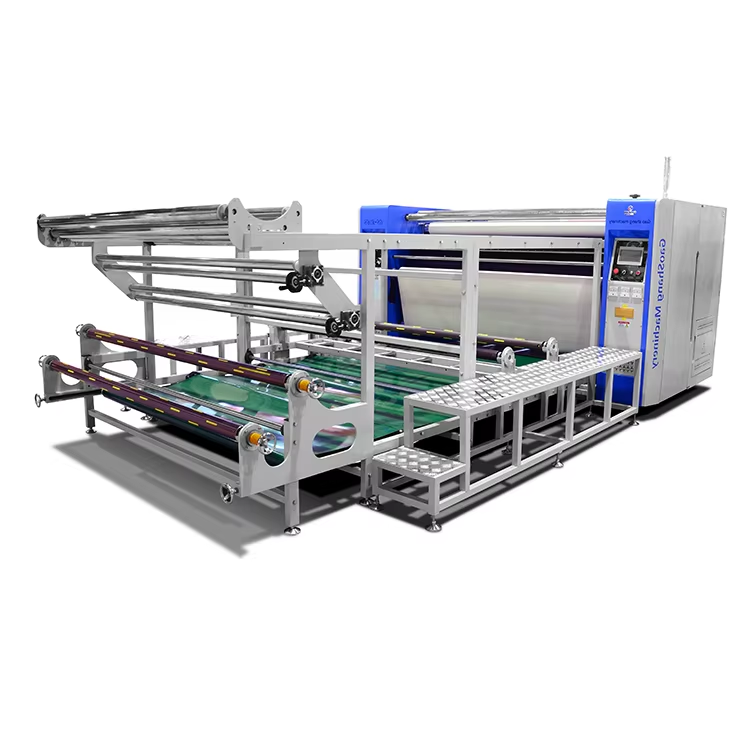
How Roll to Roll Heat Press Machines Eliminate Batch Processing Bottlenecks
Batch processing with flatbed heat presses creates a stop-start workflow that limits throughput. Each garment must be manually loaded, pressed, cooled, and unloaded before the next cycle begins—forcing operators to wait through dwell times while the machine sits idle. Roll to roll heat press machines replace this disconnected rhythm with a continuous, linear flow: fabric feeds seamlessly through a heated drum without interruption, eliminating the delays inherent in batch production.
Continuous Motion vs. Stop-Start Flatbed Workflows
A flatbed press requires a complete stop for every transfer—place, lower, wait, lift, remove. Any adjustment—alignment correction, film peeling, or misfeed—extends the cycle and erodes per-hour output. In contrast, a roll to roll heat press moves the substrate at a constant speed through the heating zone. There is no pause between transfers; the next design advances toward the drum while the previous one finishes curing. This continuous motion multiplies throughput without adding labor. Factories report increasing production from roughly 40 pieces per hour on a single-station flatbed to over 100 pieces per hour with a single-lane roll to roll system.
Synchronized Thermal Transfer Across Moving Substrate
Synchronization is the technical backbone of continuous motion. The heated drum rotates at precisely the same speed as the fabric unwinder and rewinder, maintaining constant web tension. This prevents wrinkling, skewing, and uneven heat exposure—defects common in stop-start workflows. Roll to roll heat press machines use servo-driven rollers and closed-loop controllers to keep the substrate aligned and flat throughout transfer. As fabric passes under the drum, heat and pressure are applied uniformly across the full width, ensuring identical treatment for every square meter. No operator intervention is needed to correct thermal drift or slack. The result is repeatable, high-quality output matching the consistency of automated lines—not manual batch tables.
Labor, Speed, and ROI: Quantifying Efficiency Gains from Roll to Roll Heat Press Machines
68% Reduction in Manual Handling Time per Linear Meter
Roll to roll heat press machines eliminate the repetitive loading, positioning, and unloading required in flatbed workflows. Fabric moves automatically from unwind to rewind, removing the need for manual alignment between cycles. This shift reduces manual handling time by up to 68% per linear meter. Where flatbed operations often require multiple workers to feed, press, and stack, a single operator can oversee the entire roll to roll process—delivering smoother workflow, fewer interruptions, and higher throughput per labor hour.
ROI Achieved in Under 14 Months Through Labor and Downtime Savings
The financial returns from adopting a roll to roll heat press machine are rapid and measurable. Cutting manual handling by two-thirds significantly lowers labor costs: a typical garment factory processing 200,000 linear meters annually can reduce operator headcount from three to one per shift, saving approximately $80,000 per year (based on $20/hour wages). Downtime also falls—fewer changeovers, adjustments, and material swaps mean more uptime. Combined, these gains enable full return on investment in under 14 months. The elimination of batch-processing bottlenecks further frees floor space and improves overall equipment effectiveness—making the upgrade a clear operational and financial win.
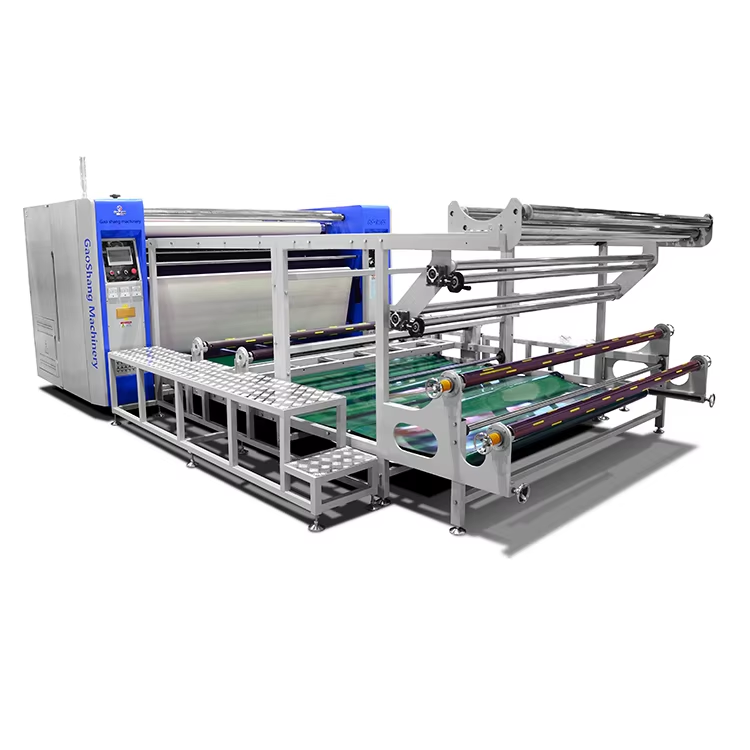
Precision Quality Control at Scale: Thermal Uniformity and Tension Management
Maintaining ±0.3°C Thermal Uniformity at High Line Speeds
Advanced roll to roll heat press machines achieve thermal uniformity within ±0.3°C—even at line speeds exceeding 15 m/min. Unlike flatbed systems prone to temperature droop during platen cycling, roll to roll setups use multi-zone PID controllers and continuous infrared feedback to compensate in real time for material thickness variations and speed fluctuations. Synchronized tension control ensures constant fabric-to-roller contact, eliminating air gaps that cause cold spots. Integrated sensors log temperature data at every production point and trigger alerts when deviations exceed tolerance. This precision supports first-pass yields above 98%, reducing defects like incomplete curing or color shifting. For high-value garment printing, holding this tight thermal window ensures compliance with international color fastness and adhesion standards—minimizing rework and regulatory risk. The roll to roll heat press machine thus serves as a cornerstone of consistent, waste-free production.
FAQs
What is a roll to roll heat press machine?
A roll to roll heat press machine is a form of transfer technology that uses a heated rotating drum to apply pressure and heat to continuous fabric or substrate, enabling seamless production workflows instead of batch processing.
How does it improve efficiency compared to flatbed presses?
Unlike flatbed presses that rely on stop-start workflows, roll to roll heat presses enable a continuous motion, significantly increasing throughput and reducing labor needs by automating fabric feeding and handling.
How quickly can ROI be achieved with roll to roll heat press machines?
Factories typically achieve a return on investment in under 14 months due to reductions in labor costs, downtime, and increased production speed.
What makes these machines suitable for high-volume production?
The machines maintain precise thermal uniformity and tension control, ensuring consistent, high-quality output at line speeds exceeding 15 m/min.

