
 EN
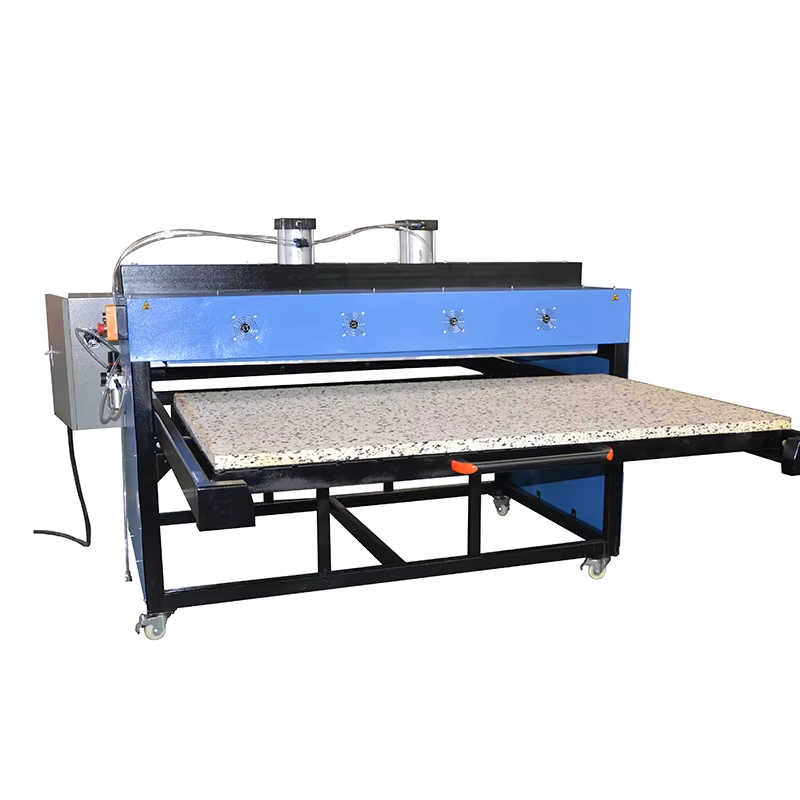
The platen size of a large format heat press defines its functional envelope. The entry point for "large format" typically begins at 50 × 70 cm (20″ × 28″)—sufficient for A2-sized prints and full-front T-shirt transfers. Production-focused shops commonly adopt 60 × 80 cm (24″ × 32″) or 80 × 100 cm (32″ × 40″) platens for greater throughput and flexibility. At the top of the standard industrial range sits the 100 × 140 cm (40″ × 60″) press, capable of sublimating an entire yard of fabric or processing gang-sheet DTF layouts in one cycle. These dimensions straddle metric and imperial systems because global sourcing means machines are designed around both ISO paper standards and US-letter workflows; for example, a 32″ × 42″ platen is functionally equivalent to an 80 × 106 cm unit. Beyond 100 × 140 cm, custom platens can exceed 150 × 200 cm for niche applications like architectural membrane printing—but those fall outside standard catalogued offerings. For complete sizing options and equipment specifications, explore our comprehensive guide on
Classifying by Use Case: Standard, Extra-Large, and Industrial Large Format Heat Press Machines
Practical sizing follows three use-driven tiers:
-
Standard Large Presses: Typically 38 × 38 cm to 40 × 50 cm (15″ × 15″ to 16″ × 20″). These serve as bench-top workhorses for apparel decoration—handling full-front T-shirts, sports jerseys, and tote bags on single-phase power.
-
Extra-Large Models: Roughly 46 × 51 cm up to 100 × 163 cm (18″ × 20″ to 40″ × 64″). They enter wide-format territory, enabling seamless all-over hoodie prints, flag graphics, and soft signage without piecing. Their extended platens preserve visual integrity and speed.
-
Industrial Large Format Presses: Measuring 100 × 140 cm and beyond, these units are built for sustained production. They maintain temperature uniformity within ±2°C (±3.6°F) across the full platen—a non-negotiable requirement for high-volume DTF and sublimation where thermal inconsistency causes dye migration or under-transfer. Many feature interchangeable lower platens, allowing rapid switching between flat-paper and elevated-garment configurations—future-proofing shops for diverse product lines without dedicated floor space per application.
Aligning Large Format Heat Press Machine Size with Production Volume
Selecting the right platen dimensions directly impacts output capacity. A press that is too small creates bottlenecks, while an oversized unit wastes energy and floor space. Matching size to daily targets ensures throughput aligns with operational demand.
Cycle Time, Daily Output Capacity, and Throughput Efficiency by Platen Size
Cycle time includes pressing, opening, loading, and unloading. While larger platens may require slightly longer warm-up periods, their ability to process multiple items per cycle significantly boosts efficiency. A 50 × 70 cm (20″ × 28″) press accommodates two adult T-shirts side-by-side; a 100 × 140 cm (40″ × 60″) model handles four to six.
Assuming a 15-second pressing time and a 15-second manual changeover on an 8-hour shift, daily outputs scale as follows:
-
50 × 70 cm: 2 items per cycle | 120 cycles per hour | 1,920 daily output
-
70 × 100 cm: 3–4 items per cycle | 110 cycles per hour | 2,640–3,520 daily output
-
100 × 140 cm: 5–6 items per cycle | 100 cycles per hour | 4,000–4,800 daily output
These figures illustrate how modest increases in platen area yield substantial gains in daily volume. Throughput further improves with pre-heated lower platens and fast-release mechanisms that reduce idle time. Industrial-grade units rated for ISO-compliant 50,000+ cycle durability sustain consistent thermal performance over time—minimizing rework caused by inconsistent pressure or cooling spots. When forecasting daily order volumes above 2,000 units, upgrading from a 50 × 70 cm to an extra-large format becomes an essential data-driven decision.
Scalability for Gang-Sheet DTF and High-Volume Sublimation Workflows
Gang-sheet printing is central to cost-effective production. With direct-to-film (DTF) transfers or sublimation paper, multiple designs are arranged on a single large sheet. A 100 × 140 cm press holds an entire gang sheet without trimming—enabling simultaneous pressing of dozens of small items (hat patches, socks, phone cases) in one cycle. This cuts paper waste and handling time versus cutting sheets for smaller presses.
Similarly, sublimating banners, flags, or full-width fabric rolls demands a platen wide enough to cover the transfer in a single pass. Units sized 44″ × 64″ and larger accommodate standard 3- and 4-foot polyester rolls without repositioning—eliminating seam marks from overlapping presses. By aligning press size with your gang-sheet layout, you scale efficiently: moving from 100 to over 1,000 pieces per day without adding shifts. Choosing a large format heat press that matches your gang-sheet dimensions future-proofs your line and keeps per-unit costs low as volume grows.
Application-Driven Sizing: Matching Large Format Heat Press Machines to End Products
Apparel & Home Textiles: Optimal 26″×32″ to 32″×42″ Presses for Precision and Fabric Handling
For garment decoration and home textiles, platen width directly affects registration accuracy and fabric handling. Machines in the 26″ × 32″ to 32″ × 42″ range align precisely with adult apparel and cushion covers—allowing full-chest logos or all-over sublimation transfers in a single, drift-free cycle. This eliminates the misalignment risks inherent in multi-pass setups using smaller platens.
The moderate footprint also supports efficient gang-sheet layouts for youth garments, totes, and pillowcases—keeping labor cost per impression low. With calibrated pressure control, these presses deliver consistent nip across cotton, polyester, and blends—reducing scorch risk on delicate fabrics. Their compact floor presence makes them ideal for studios balancing moderate daily volumes with high print fidelity.
Banners, Flags, and Seamless Graphics: Why 44″×64″+ Large Format Heat Press Machines Are Essential
When producing large polyester banners, flags, or continuous fabric graphics, smaller platens force tiling—introducing visible seams and uneven adhesion. Industrial applications require a minimum of 44″ × 64″ to cover standard 3- and 4-foot synthetic rolls in one pass. The expansive heating surface ensures uniform temperature distribution—critical for consistent dye sublimation on polyester substrates.
Higher frame rigidity and precision hydraulic or pneumatic controls deliver steady, warp-free pressure across broad areas—preventing ghosting or incomplete transfer. Pressing whole panels—not sections—sharply increases speed while maintaining quality uniformity. For sign shops, event décor providers, and flag manufacturers, 44″ × 64″+ presses are foundational to scalable, professional-grade output.
Frequently Asked Questions (FAQ)
-
What is the starting size for large format heat presses?
Large format heat presses typically start at 50 × 70 cm (20″ × 28″), suitable for A2-sized prints and full-front T-shirt transfers.
-
What daily output can I expect from different platen sizes?
Depending on the platen size, daily output ranges from 1,920 units for 50 × 70 cm to 4,800 units for 100 × 140 cm presses, assuming an 8-hour shift with 15-second pressing cycles.
-
How do large format heat presses reduce production time?
Larger platens allow multiple items to be pressed simultaneously, speeding up production. They also eliminate the need for repositioning or tiling, especially for banners or gang-sheet layouts.
-
Why are 44″×64″+ presses essential for banners and flags?
These presses ensure seamless coverage for polyester rolls, prevent visible seams, and maintain uniform temperature distribution across the substrate for professional-grade output.
-
Can large format heat presses handle different fabric types?
Yes, presses with calibrated pressure control can handle various fabric types, ensuring consistent results on cotton, polyester, and blends without scorching delicate fabrics.

