 EN
The Labor Crisis Driving Adoption of the Auto Heat Press Machine
Rising Wage Pressures and Staff Shortages in U.S. Screen & DTG Printing Shops
U.S. apparel decoration shops face a tightening labor market that directly undermines profitability. Manufacturing wages rose 4.8% year-over-year in 2023 (Bureau of Labor Statistics), while printing and related support activities saw a 5.2% increase. Simultaneously, the industry’s pool of available press operators continues to shrink—77% of firms reported ongoing difficulty attracting and retaining skilled production workers, according to a 2023 National Association of Manufacturers survey. For direct-to-garment (DTG) and screen printing environments, the pressure is acute: jobs require physical stamina, precision, and consistent heat and dwell time control. Short-staffed shops often rely on overtime, further inflating labor costs. The manual heat press bottleneck is no longer just a production constraint—it is a financial liability. Firms that adopt an auto heat press machine can reallocate one operator to oversee multiple stations, directly addressing both wage inflation and the scarcity of qualified hands.
Why Manual Heat Press Operations Are No Longer Scalable or Sustainable
Scaling a manual heat press operation simply multiplies its core weaknesses. Each additional press demands a dedicated operator, and human performance degrades across shifts due to fatigue—leading to inconsistent temperature application, misaligned transfers, and costly rework. Error rates in manual pressing average 3–5% of garments, eroding margins and material budgets. A 2022 industry benchmarking study found that a single manual press operator could reliably produce only 60–80 pieces per hour, while a well-designed automated system managed 150–200 pieces per hour with one operator. Without automation, businesses remain locked in a linear relationship between labor and output—making growth too expensive and too fragile. In contrast, automated heat press systems run pre-programmed cycles, maintain uniform pressure through pneumatic controls, and log every cycle for quality assurance.
How the Auto Heat Press Machine Cuts Labor Costs—Mechanics and Metrics
Decoupling Output from Headcount: Cycle Automation, Hands-Free Clamping, and Smart Timers
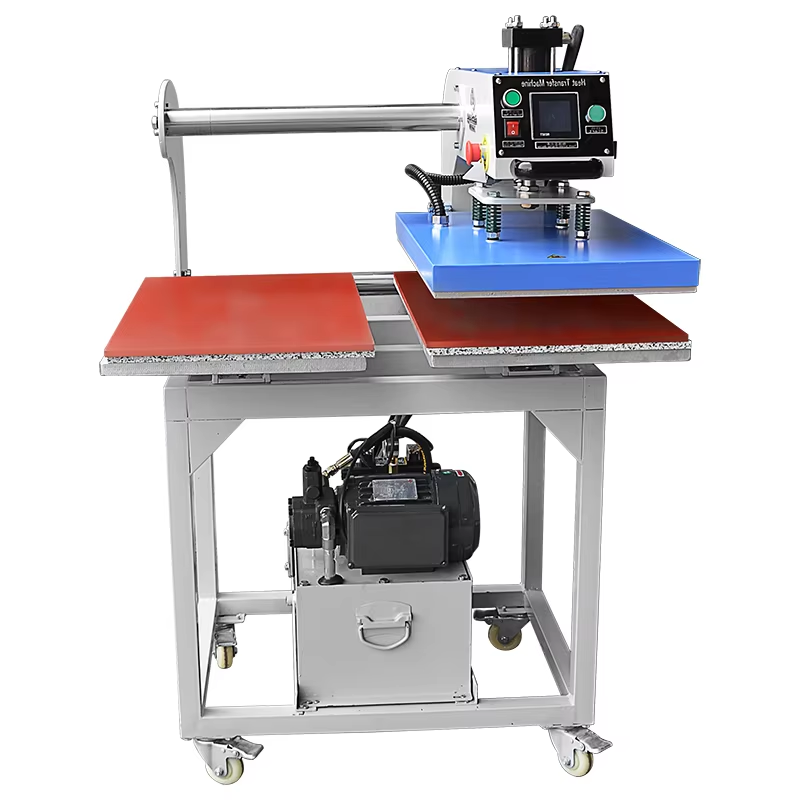
Cycle automation breaks the direct link between headcount and production volume. An auto heat press machine sequences pre-pressing, dwell, and release without manual intervention—enabling one worker to oversee multiple stations. Hands-free clamping systems, often pneumatic or magnetic, hold garments in exact registration, eliminating the need for manual alignment. Smart timers adjust dwell duration automatically based on material thickness or transfer type, preventing over-curing and rework. This integration of sensors and preset programs places critical quality variables under machine control—not operator discretion. According to a 2023 analysis by the Specialty Graphic Imaging Association, shops adopting automated heat press systems reduce direct labor per unit by 40–60%, as the same headcount handles significantly higher throughput. The result is a scalable production line where output climbs without adding staff.
Quantified Gains: 62% Fewer Labor Hours per Shift (Midwest Case Study)
A 2023 Midwest case study from a mid-volume contract decorator illustrates the real-world impact. The shop previously ran three manual heat press stations, each requiring a dedicated operator for loading, timing, and peeling. After deploying two auto heat press machines, one operator managed both stations—and total labor hours per shift fell by 62%. Daily operator-hours dropped from 24 to just over 9, while maintaining identical output. Automated pressure and dwell control also cut rework rates from 6% to 1.5%, freeing staff from re-pressing defective transfers. Training time for new hires declined because the machine’s interface guided the process, and injury risks from repetitive motion decreased. With a payback period of under seven months from labor savings alone, the shop scaled to take on larger orders without proportional staffing increases.
ROI and Operational Impact of Deploying an Auto Heat Press Machine
Labor Reallocation ROI: Payback in Under 8 Months Without Factoring in Quality or Throughput Gains
The financial case for an auto heat press machine begins with direct labor displacement—typically delivering payback in under eight months. A typical mid-volume shop running two manual stations requires two operators per shift. At a blended U.S. wage of $18–$22 per hour, each operator represents roughly $37,000 in annual direct labor cost. Transitioning to a single automated system that consolidates loading, pressing, and unloading into one synchronized cycle eliminates the need for the second operator. That reallocation alone generates $30,000–$40,000 in annual savings—covering the incremental capital cost of the automation within the first year. This calculation excludes secondary gains from faster cycle times, higher daily throughput, and defect reduction, meaning the stated payback window is conservative. In practice, when a leading manufacturer integrated automated pressure and dwell controls, they observed rework rates drop from 7% to under 1.5%, accelerating true ROI.
Scalability Proof Point: One Operator Managing Three Auto Heat Press Stations
Scalability with an auto heat press machine is defined by the operator-to-station ratio—the key determinant of peak labor efficiency. In manual workflows, this ratio is fixed at 1:1. Automated systems invert that constraint: a single operator can manage three stations simultaneously because the machine handles clamping, dwell timing, and release without human intervention. The operator’s role shifts to material staging and final quality inspection—the only tasks requiring human judgment. If one operator oversees 250–300 pieces per hour across three machines, labor cost per print drops by over 60% compared to a manual setup producing the same volume. This model makes it possible to double or triple output without hiring additional staff—directly resolving the scalability bottleneck that limits manual printing shops.
FAQ
What is the primary advantage of auto heat press machines?
Auto heat press machines automate tasks such as clamping, dwell timing, and release, breaking the dependence on manual operators and significantly increasing production output and consistency.
How does deploying an auto heat press machine reduce labor costs?
These machines allow one worker to oversee multiple stations simultaneously, reducing the number of operators needed and lowering overall labor expenses.
What are the scalability benefits of using automated heat presses?
Automated systems enable a single operator to manage multiple machines, making it possible to double or triple output without proportional increases in staffing.
How long does it take to achieve ROI with an auto heat press machine?
Payback periods are typically under eight months due to labor savings alone, with faster throughput and defect reduction further enhancing ROI.
Can auto heat press machines improve product quality?
Yes, automated systems maintain uniform pressure and temperature, reducing defects and ensuring consistent transfer quality.
Table of Contents
- The Labor Crisis Driving Adoption of the Auto Heat Press Machine
- How the Auto Heat Press Machine Cuts Labor Costs—Mechanics and Metrics
- ROI and Operational Impact of Deploying an Auto Heat Press Machine
-
FAQ
- What is the primary advantage of auto heat press machines?
- How does deploying an auto heat press machine reduce labor costs?
- What are the scalability benefits of using automated heat presses?
- How long does it take to achieve ROI with an auto heat press machine?
- Can auto heat press machines improve product quality?

