
 EN
EN
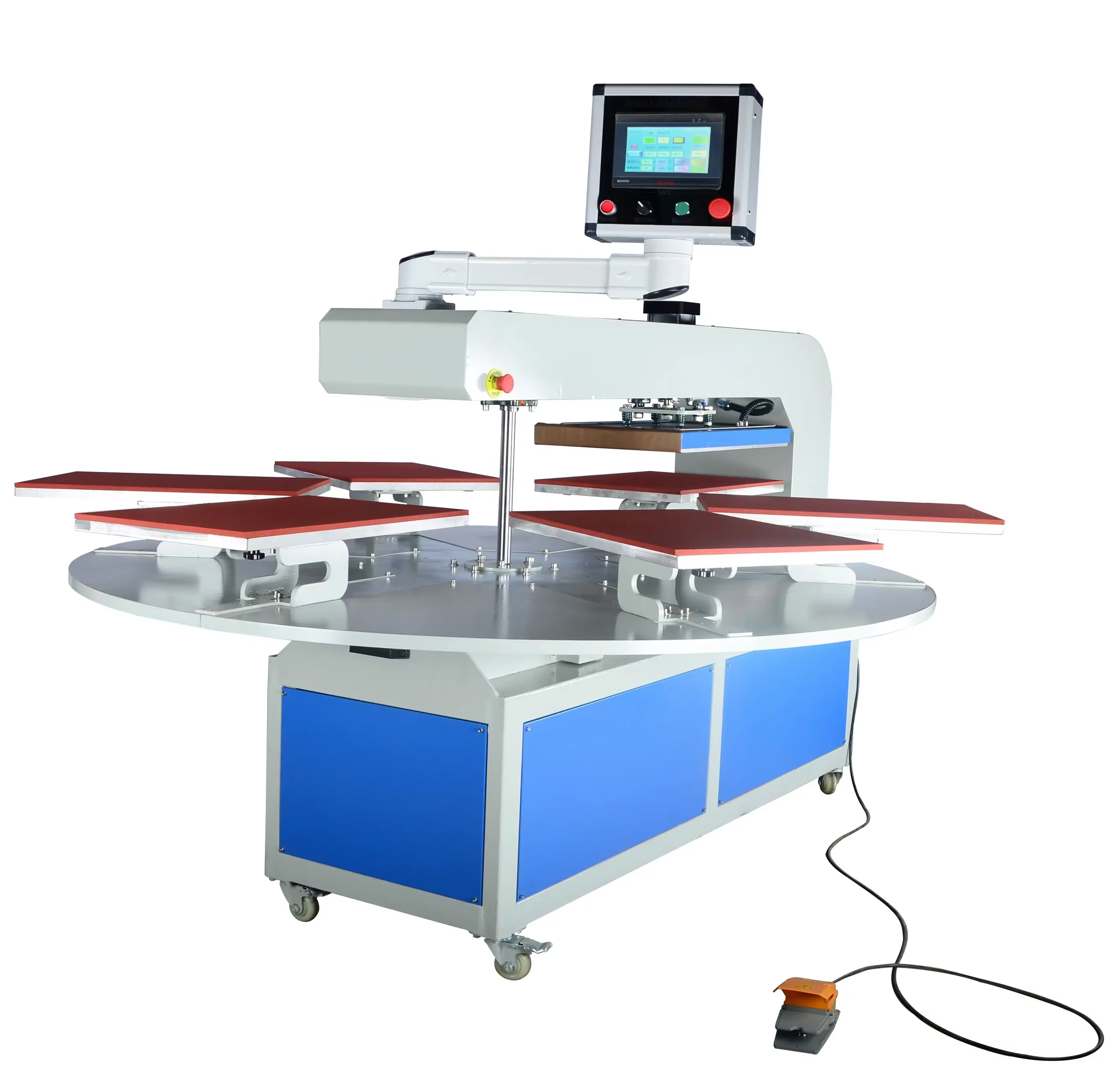
Core Functional Differences of a Dual Heat Press Machine
Independent Dual Platens Enable True Simultaneous Operations
A dual heat press machine redefines production workflow by housing two independently controlled platens—each managing its own temperature, pressure, and dwell time. While one platen executes a transfer, the operator loads or unloads the other. This eliminates the idle window inherent in single-station presses, where the entire process stalls during garment handling. The lower platens remain fixed, and the upper heating head shuttles between them—a design that transforms a stop-and-wait batch process into continuous flow. Operators never pause pressing to prepare the next blank; one station is always active.
Independent control also enables mixed-product runs: different transfers can be applied simultaneously on each platen, provided their parameters align. The result is not just a theoretical doubling of capacity, but a sustained increase in effective output—driven by eliminated non-productive time rather than raw speed.
How Dual-Station Workflow Reduces Cycle Time by Up to 40%
The “ping-pong” workflow slashes per-item cycle time by overlapping manual tasks (loading/unloading) with automatic pressing. On a single-platen machine, operators must wait for the press to open, remove the finished item, position the new blank, and trigger the cycle—all sequentially. In contrast, the dual-station design lets the heating head move instantly to the ready station while the other is being prepared. Since loading and unloading typically consume 25–35% of a single-station job’s total time, overlapping them with pressing removes that segment entirely from the timeline.
Factory-floor studies consistently show this reorganization cuts per-item cycle time by 30–40% compared to identical jobs on single-station equipment. For example, with a 15-second pressing time, a dual-station machine completes a full load-press-unload cycle in ~20 seconds, versus ~35 seconds on a single-station unit. That sustained 40% improvement isn’t aspirational—it reflects real-world throughput gains achievable by one operator without added strain.
Operational Workflow Advantages of a Dual Heat Press Machine
Eliminating Idle Time Through Continuous Pressing Cycles
A single-station press forces a rigid, sequential rhythm: load → press → unload → repeat. Each cycle embeds idle time—especially during transitions—eroding hourly output. The dual heat press replaces that with a seamless “press-prepare” loop: while one platen is pressing, the operator loads the next garment onto the second station. As soon as the first press opens, the finished item is removed and the pre-loaded second station engages—no waiting, no wasted motion.
This continuous-motion workflow eliminates accumulated downtime over a shift. Operators stay engaged in productive activity—not paused, watching timers. Throughput rises significantly without adding labor, simply by aligning human and machine actions around simultaneous operation.
Reduced Operator Fatigue and Improved Safety vs. Repetitive Single-Station Tasks
Single-station operation demands high-cadence repetition: constant bending, reaching, and rushing between cycles—leading to physical fatigue and mental burnout. A dual-station setup distributes effort more evenly. Operators alternate between active loading and brief standing intervals while the press cycles autonomously, reducing the cumulative musculoskeletal stress linked to repetitive motion.
Many dual heat press models integrate pneumatic or motorized sliding systems, minimizing manual force required to position platens. Safety enhancements—including emergency stop bars and dual-hand activation controls—ensure the operator is clear before engagement, lowering risks of burns or pinch-point injuries. By designing for steady, deliberate motion rather than hurried repetition, dual-station machines improve both ergonomics and workplace safety.
Precision Engineering: Temperature, Pressure, and Consistency in a Dual Heat Press Machine
Independent PID Controllers Ensure <±1.2°C Platen-to-Platen Temperature Uniformity
Each platen in a dual heat press is governed by its own dedicated PID (Proportional-Integral-Derivative) controller—a closed-loop system that samples temperature multiple times per second and dynamically adjusts heater output. This ensures stable, responsive thermal regulation with cross-platen variance held to under ±1.2°C—significantly tighter than the ±3°C typical of entry-level single-station units.
The PID algorithm compensates for thermal lag and ambient fluctuations, preventing overshoot that could scorch fabrics or undershoot that might cause poor transfer adhesion. When paired with consistent pressure delivery (often within ±0.02 MPa across stations), this precision guarantees uniform curing conditions for every garment. For brands requiring exact color fidelity, edge definition, and bond integrity across high-volume runs, such repeatability isn’t optional—it’s foundational.
Business Impact: ROI, Space Efficiency, and Scalability of Dual Heat Press Machines
ROI Threshold Analysis: When Dual-Station Investment Pays Off in Under 6 Months
Though dual-station presses carry a 30–50% price premium over comparable single-station models, their throughput advantages drive rapid return on investment. For a shop processing 500 garments daily, the 30–40% cycle-time reduction effectively adds ~200 units of capacity per day—without hiring additional staff. At a conservative net margin of $2 per piece, that translates to $400 in incremental daily profit.
With a typical equipment premium of $2,000–$3,000, payback occurs in just 5–8 working days. Even in moderate-demand scenarios—where added volume is sold at wholesale—the payback period rarely exceeds six months. Crucially, the time freed up by eliminating idle cycles doesn’t vanish; it’s redirected toward order fulfillment, quality assurance, or customer service—further amplifying operational ROI. For growing printed apparel businesses, the dual heat press machine represents a low-risk, high-leverage step toward scalable, sustainable production.
FAQs About Dual Heat Press Machines
What sets a dual heat press machine apart from single-station designs?
The primary difference lies in the dual platens, which operate independently. This allows simultaneous loading and pressing, eliminating idle times and significantly boosting throughput.
How does the dual-station workflow reduce cycle time?
By allowing the operator to overlap loading/unloading tasks with pressing, a dual heat press minimizes downtime and cuts cycle time by up to 40% compared to single-station units.
Is the temperature consistency better in dual heat press machines?
Yes, dual heat press machines use PID controllers to maintain precise temperature uniformity, achieving a variance of less than ±1.2°C between platens.
What are the safety benefits of dual-station models?
Dual-station machines include features like emergency shut-off and dual-hand activation to enhance operator safety, while reducing repetitive stress and physical fatigue.
How quickly does a dual heat press machine pay for itself?
For most businesses, the increased productivity allows a dual heat press machine to recoup its investment within six months, depending on overall demand and garment pricing.
Table of Contents
- Core Functional Differences of a Dual Heat Press Machine
- Operational Workflow Advantages of a Dual Heat Press Machine
- Precision Engineering: Temperature, Pressure, and Consistency in a Dual Heat Press Machine
- Business Impact: ROI, Space Efficiency, and Scalability of Dual Heat Press Machines
-
FAQs About Dual Heat Press Machines
- What sets a dual heat press machine apart from single-station designs?
- How does the dual-station workflow reduce cycle time?
- Is the temperature consistency better in dual heat press machines?
- What are the safety benefits of dual-station models?
- How quickly does a dual heat press machine pay for itself?

