 EN
Eliminating Downtime with Concurrent Dual-Station Operation
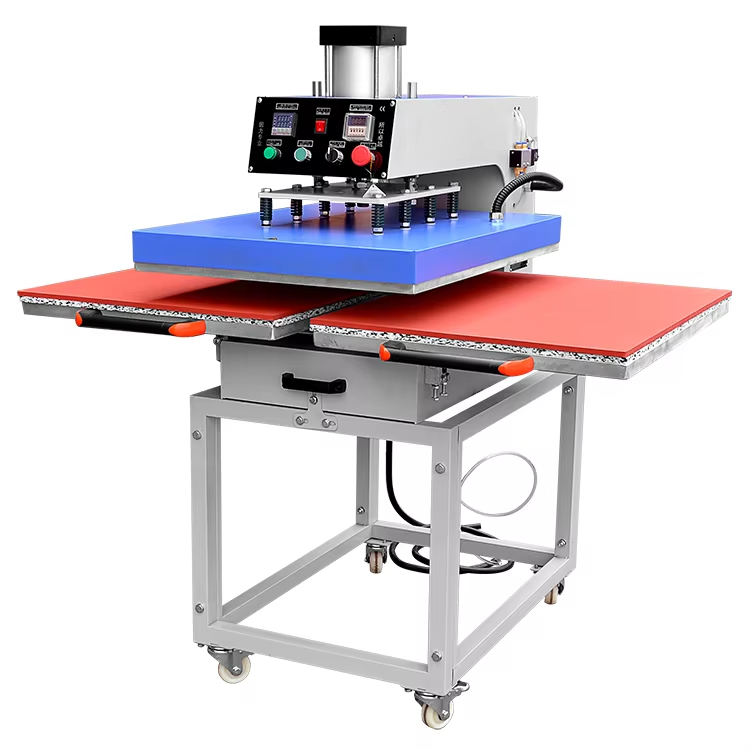
A double station heat press machine addresses one of the biggest hidden costs in garment decoration: idle heat and idle hands. Instead of a single platen that forces loading, pressing, and unloading to happen sequentially, the dual-station design separates these tasks across two lower platens.
How Independent Platen Control Enables True Parallel Processing
Independent platen control means each lower platen can be moved, locked, or released on its own schedule. One platen stays under the heated upper platen while the other is pulled out for garment setup or removal—creating two overlapping work zones. The operator loads a shirt on station A, swings or slides station B into the heat zone, and removes finished work without interrupting the cycle. Because the upper heating element remains engaged continuously, heat transfer stays consistent and temperature recovery time drops sharply. In contrast, a standard single-station press loses heat during loading, forcing the controller to compensate—a thermal cycle that risks inconsistent adhesion and scorching. With dual-station operation, one platen stays insulated under heat for most of the cycle, stabilizing the upper element’s thermal load. This mechanical separation of pressing and handling enables true parallel processing—and forms the foundation for eliminating downtime and sustaining higher output per shift.
Real-World Impact: 42% Throughput Gain in a Print-on-Demand Fulfillment Hub
A print-on-demand fulfillment operation that switched from two single-station presses to one double station heat press machine recorded a 42% increase in finished garments per shift in 2024. The gain came not from altering temperature or dwell time, but from eliminating the 15-second idle window between cycles—previously spent loading and unloading while the press sat open. With dual-station workflow, the operator prepared the next garment while the previous one pressed. Labor hours remained constant, yet non-pressing time fell from 34% to 11% of the total cycle. That translated to the equivalent of two additional hours of pressing output in an eight-hour shift—without adding staff. For high-mix, low-volume orders, this eliminated bottlenecks during peak periods and reduced order turnaround by nearly one-third. The case confirms concurrent dual-station operation delivers measurable, real-world throughput economics—not just theoretical efficiency.
Optimizing Labor and Workflow with a Double Station Heat Press Machine
From Batch to Continuous Flow: Streamlining Production Cadence
Batch decoration often follows a stop-start rhythm: load, press, wait, unload, repeat. A double station heat press machine transforms that into continuous flow. While one platen is under heat, the operator aligns the next garment on the second platen. The shuttle or swing-away design allows loading and pressing to overlap rather than compete for the same interval—eliminating idle dwell and keeping the operator engaged in value-adding setup instead of waiting. In high-volume environments, dual-station equipment can cut production time by up to half because setup time is absorbed into the press cycle. One print-on-demand hub replaced four manual presses with two dual-station systems and achieved daily output of 1,400 shirts using only two operators. This flow reduces batching, lowers work-in-process inventory, and shortens total job time—all without requiring additional equipment. The result is a steadier cadence, fewer rushed transitions, and less unplanned downtime around loading.
One Operator, Two Stations — Maximizing Human Efficiency Without Added Headcount
Traditional high-volume runs often demand either multiple manual presses or extra operators to keep pace. A dual-station design relieves that pressure: one operator can load the second platen while the first is pressing, keeping both stations active without hiring a second person. Because the press cycle and setup task run in parallel, labor shifts from passive waiting to active preparation—removing idle time from the operator’s motion path. The operator stays on one side, uses a consistent shuttle movement, and maintains a repeatable left-right rhythm. In the same fulfillment setting mentioned above, replacing four manual presses with two dual-station machines maintained high output with just two operators—avoiding added payroll and floor space. For small teams and print-on-demand shops, that labor efficiency often becomes the fastest path to profit, as throughput rises without a matching increase in overhead.
Output Gains and Cycle Time Realities: Single vs Double Station Heat Press Machine
Why Output Scales Near-Linearly (But Not Exactly) — Addressing the Diminishing-Return Myth
A double station heat press machine creates two independent work zones, allowing one garment to be pressed while the operator loads or unloads the other platen. This overlap removes much of the idle time inherent in single-station production. In principle, output should nearly double—but real-world gains land slightly below 100% due to shared labor constraints: alignment, pre-press, and inspection still require operator attention, and minor thermal stabilization occurs after platen swaps. These factors don’t reflect diminishing returns; they correct the unrealistic assumption of zero transition cost. Most high-volume decoration lines report throughput gains of 50–70%, not 100%, because the bottleneck shifts from the press itself to operator handling. This near-linear scalability makes dual-station operation a practical, high-impact upgrade for growing shops.
Measured Improvement: Cycle Time Reduction from 92s to 58s in Standard Garment Decoration
In a standard garment decoration workflow, effective takt time dropped from 92 seconds on a single-station press to 58 seconds with dual-station operation—a 34-second reduction representing a 37% shorter interval between finished pieces. Over one hour, output rose from about 39 garments to 62 garments: a 59% throughput increase. Operators maintained identical pressure, temperature, and dwell settings, confirming the gain stemmed entirely from workflow overlap—not compromised quality controls. This data validates that overlapping loading and pressing compresses cycle time without altering core process parameters.
FAQ
-
What is a double station heat press machine?
A double station heat press machine has two platens, allowing pressing and preparation tasks to occur simultaneously, eliminating idle time. -
What are the benefits of dual-station operation?
It allows for parallel processing, higher output, reduced downtime, and labor efficiency without requiring additional staff or equipment. -
How much throughput can I expect with dual-station workflow?
Throughput typically increases by 50–70% compared to single-station presses, depending on operator efficiency and workflow setup. -
Does the dual-press design affect heat consistency?
No, it maintains consistent thermal load by keeping one platen heated continuously, ensuring uniform temperature. -
Can dual-station machines reduce operating costs?
Yes, they maximize human efficiency and reduce payroll needs by allowing one operator to handle both stations.

