 EN
Why Standard Heat Presses Are Inadequate for Billboard-Scale Fabric Printing
Many print shops rely on standard heat presses designed for apparel and promotional items—but these units quickly reach their limits with billboard-scale fabric production. The most obvious shortcoming is platen size: a typical clamshell press offers only a 40 cm × 60 cm work area, forcing operators to perform multiple overlapping transfer cycles for a single 5-meter graphic. Each repositioning introduces risks of visible seams and inconsistent color density—flaws that become glaringly apparent under outdoor lighting.
Temperature uniformity degrades rapidly beyond what a single-zone heater can manage. Sparse heating coils in consumer-grade presses create cold spots that prevent full sublimation into polyester or coated substrates, resulting in patchy transfers. A 2023 textile printing survey found jobs requiring more than eight repositioned cycles had a 22% higher reject rate due to alignment drift and heat-recovery delays—directly increasing material waste and labor costs.
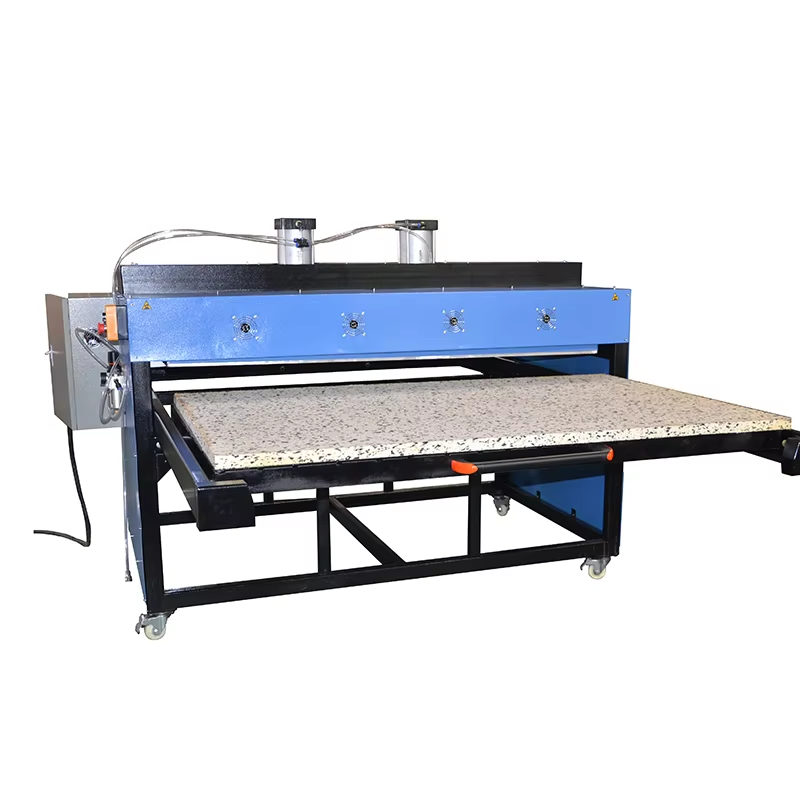
Structural rigidity also falls short. Consumer- or prosumer-grade frames flex under the sustained pressure needed for thick composite banner materials, causing uneven adhesion. For continuous, high-volume outdoor advertising output, large format heat press machines—with extended platens, multi-zone heating, and robust pneumatic systems—eliminate these failure points while preserving color fidelity across the entire artwork.
Key Technical Specifications of Large Format Heat Press Machines
Platen Size, Marking Area, and Uniform Heat Distribution Requirements
Platen dimensions directly define throughput for wide-format fabric graphics. A 1.6 m × 3 m bed enables single-cycle processing of substantial panels, drastically reducing seam work for billboards. Uniform heat distribution across such an expansive surface is the primary engineering challenge: a ±5 °C cold spot can cause visible banding and wasted material on a 5-meter banner. Advanced systems address this using multi-zone, independently controlled heating elements paired with thicker, high-grade aluminum platens. This architecture ensures the entire graphic area reaches target temperature simultaneously—typically within ±1.5 °C—enabling flawless edge-to-edge color reproduction in one pressing cycle.
Industrial vs. Apparel-Sized Units: Structural and Thermal Design Differences
A production-grade machine for billboard fabrics has little in common with a standard apparel heat press beyond the basic principle. Foundational design diverges in structural heft, power engineering, and control systems.
| Design Factor | Apparel-Sized Unit | Industrial Large Format Machine |
|---|---|---|
| Frame & Structure | Welded sheet-metal, manual clamshell | Solid cast-steel or heavy I-beam frame; automated, multi-point locking |
| Power Requirement | Single-phase, 120–220 V, 1.5–2 kW | Three-phase, 380–480 V, 12 kW and above |
| Pressure System | Manual lever or single overhead cylinder | Synchronized dual-pneumatic or hydraulic rams for parallel platen closure |
| Thermal Watt Density | ~0.5 W/cm² | ≥1.2 W/cm² for sustained, high-volume duty cycles |
| Control Logic | Basic thermostat | Multi-zone PID controllers with real-time feedback loops |
The intensified thermal watt density and rigid frame—shaped by 7 critical engineering factors behind industrial-scale heat press production—prevent platen warping. This stability ensures consistent, high-pressure contact against thick vinyl-coated polyester, a core requirement absent in lighter apparel designs.
Material Compatibility and Substrate-Specific Performance of Large Format Heat Press Machines
Selecting large format heat press machines for outdoor advertising requires rigorous evaluation of material compatibility. Billboard fabrics—such as vinyl-coated polyester weaves, dense canvas, or multi-layer composites—respond differently to heat and pressure. Standard presses optimized for thin apparel textiles cannot sustain the adhesive activation temperatures (175–210 °C) or uniform pressure needed across wide platens. Successful transfers depend on the machine’s ability to adapt to each substrate’s thermal conductivity, coating sensitivity, and thickness—without scorching, delaminating, or under-bonding.
Testing Performance on Vinyl-Coated Polyester, Canvas, and Composite Billboard Fabrics
Test protocols for large format heat press machines must isolate three fabric categories:
- Vinyl-coated polyester: Requires moderate pressure (2–4 psi) and precise temperature control (±3 °C) to prevent plasticizer migration that weakens the bond. Dwell times typically range from 18 to 30 seconds, depending on the transfer film.
- Canvas: Demands higher pressure (4–6 psi) and longer dwell (up to 45 seconds), as thick, absorbent fibers draw heat away from the transfer interface. Pre-heating the canvas for 5–10 seconds often improves adhesion.
- Composite fabrics (e.g., PVC-mesh laminates): Require low, even pressure (1.5–2 psi) to limit distortion, while temperature must stay below the laminate’s softening point (~160 °C). Only platen systems with multi-zone heating and pneumatic pressure control deliver the required consistency across a 3 m wide panel.
Without tailored parameter profiles, large-scale production risks high rejection rates from inconsistent color transfer and seam peeling.
Real-World Application: Deploying Large Format Heat Press Machines in Outdoor Advertising Production
Outdoor billboard fabric printing demands equipment that handles massive dimensions without sacrificing print durability or color vibrancy. Large format heat press machines form the backbone of sublimation transfer onto wide-format polyester banners—ensuring inks penetrate fibers deeply for weather resistance. Unlike standard garment presses, these industrial systems accommodate platen widths exceeding 1.5 meters, often using rotary or shuttle mechanisms to process lengths up to 12 meters. Production teams rely on precise temperature uniformity and pressure consistency to avoid ghosting or scorching across the entire surface.
Case Study: Rotary Large Format Heat Press Machine for 3.2m × 12m Billboard Fabric Sublimation
A signage company specializing in outdoor mega-banners integrated a rotary drum large format heat press machine to fulfill a contract for 3.2 m × 12 m billboard fabric panels. The rotary design continuously feeds fabric over a heated cylinder, achieving a consistent 200°C across the full width—as verified by infrared pyrometer readings at start, middle, and end of the roll. Sublimation transfer paper pre-printed with UV-resistant inks was matched to a 100% polyester knit weighing 280 g/m², requiring a dwell time of 45 seconds per linear metre. The machine’s tension control system prevented stretching or skew, preserving alignment of the 12 m graphic. Output reached six complete billboard panels per day—compared with two using a static flatbed press—while colorfastness testing (AATCC 61-2A) confirmed wash and light fastness ratings suitable for outdoor exposure up to 24 months. The success hinged on the rotary large format heat press machine’s ability to deliver uniform heat and pressure over a continuous web, eliminating seam marks and reducing labor-intensive manual repositioning.
FAQs
Why are standard heat presses unsuitable for billboard-scale fabric printing?
Standard heat presses lack the platen size, temperature uniformity, and structural rigidity necessary for large-format production, leading to flaws such as seams and patchy transfers.
What are the key advantages of large format heat press machines?
These machines offer extended platen sizes, multi-zone heating, robust pneumatic systems, and precise pressure control. These features ensure consistent and high-quality transfers for billboard fabrics.
What types of fabrics are suitable for large format heat press machines?
Suitable fabrics include vinyl-coated polyester, canvas, and composite materials like PVC-mesh laminates. Each requires specific heat and pressure settings for optimal results.
How do large format heat presses differ from standard apparel presses?
Large format presses feature heavier frames, higher power wattage, synchronized pressure systems, and sophisticated control logic. These design differences address the demands of industrial-scale sublimation.
What is a rotary heat press machine, and why is it effective for large banners?
A rotary heat press machine uses a heated cylinder to continuously process fabric, ensuring consistent heat and pressure across large dimensions—ideal for seamless 3.2 m × 12 m panels.
Table of Contents
- Why Standard Heat Presses Are Inadequate for Billboard-Scale Fabric Printing
- Key Technical Specifications of Large Format Heat Press Machines
- Material Compatibility and Substrate-Specific Performance of Large Format Heat Press Machines
- Real-World Application: Deploying Large Format Heat Press Machines in Outdoor Advertising Production
-
FAQs
- Why are standard heat presses unsuitable for billboard-scale fabric printing?
- What are the key advantages of large format heat press machines?
- What types of fabrics are suitable for large format heat press machines?
- How do large format heat presses differ from standard apparel presses?
- What is a rotary heat press machine, and why is it effective for large banners?

